Good morning.
Today the Church keeps the Memorial of the Presentation of the Blessed Virgin Mary. The first reading is the Apocalypse again, the two witnesses; the Gospel is the Sadducees and the question about the resurrection.
Memorial of the Presentation of the Blessed Virgin Mary
First reading (Apocalypse 11:4-12): John hears a voice from heaven speak of two witnesses: "These are the two olive trees, and the two candlesticks, that stand before the Lord of the earth." They prophesy, and when they have finished their testimony the beast that rises from the abyss makes war on them and kills them. Their bodies lie in the street of the great city, and the peoples of the earth look at them for three days and a half and rejoice and send gifts to one another, "because these two prophets tormented them that dwelt upon the earth." Then: "after three days and a half, the spirit of life from God entered into them. And they stood upon their feet, and great fear fell upon them that saw them. And they heard a great voice from heaven, saying to them: Come up hither. And they went up to heaven in a cloud: and their enemies saw them." The Douay-Rheims carries Bishop Challoner's note on the two witnesses: "It is commonly understood of Henoch and Elias." The Responsorial refrain is "Blessed be the Lord, my Rock!" (Psalm 144, which the Douay-Rheims numbers 143).
The Gospel (Luke 20:27-40): The Sadducees, "who deny that there is any resurrection," put the case of a woman who married seven brothers in turn: "In the resurrection therefore, whose wife of them shall she be?" Jesus answers: "they that shall be accounted worthy of that world, and of the resurrection from the dead, shall neither be married, nor take wives. Neither can they die any more: for they are equal to the angels, and are the children of God, being the children of the resurrection." And then Moses at the bush, who called the Lord "the God of Abraham, and the God of Isaac, and the God of Jacob. For he is not the God of the dead, but of the living: for all live to him." Some of the scribes say, "Master, thou hast said well," and after that "they durst not ask him any more questions."
The full readings are on USCCB.org.
bible.usccb.org/bible/readings/112126.cfm →
A word from the Catena Aurea. Augustine on why there is no marriage in the resurrection: "marriages are for the sake of children, children for succession, succession because of death. Where then there is no death, there are no marriages." Bede on the last line, "for all live to him": "that is a true life which the just live to God, even though they are dead in the body." And Chrysostom on why God names Himself after three men: He calls Himself especially the God of Abraham, Isaac and Jacob, "not thereby narrowing but enlarging His dominion; for it is not so much the multitude of His subjects that manifests His power, as the virtue of His servants."
The Gospels say nothing of it. The account comes from the Protoevangel of James, the Gospel of Pseudo-Matthew, the Gospel of the Nativity of Mary and other apocryphal writings, and the Catholic Encyclopedia gives it in a sentence: Mary, at the age of three, was brought by her parents to the temple, in fulfillment of a vow, to be educated there.
The feast is older in the East than in the West. It seems to have begun in Syria, the home of the apocrypha. A Greek canon for it, by a "Georgios," dates from about the seventh or eighth century. By 1166 the Emperor Manuel Comnenos had it as a full holiday on which the law courts did not sit. In the West it was brought by Philippe de Mazières, Chancellor of the King of Cyprus, who spent time at Avignon under Pope Gregory XI. It was celebrated in the presence of the cardinals in 1372, taken up by the royal chapel at Paris in 1373, at Metz in 1418 and at Cologne in 1420. Sixtus IV received it into the Roman Breviary. Pius V struck it from the calendar, and Sixtus V took it up a second time, in 1585.
That is a long road for a feast whose story is not in Scripture. The Church took it up anyway, and the reason is plain in what the story says: a child given to God before she could know what it would cost, by parents keeping a vow.
A reading of our own, not a Father's. Yesterday the Lord went into the temple and drove out the sellers. Today the temple holds a child who has been given to it. Everything in Friday's Gospel was about what may be sold; the Presentation is about what is simply given. The Gospel today ends where Chrysostom leaves it: the God of Abraham is a God of the living, and "all live to him." A life given to God is not a life lost, and we find that easy to say on a day when nothing is falling.
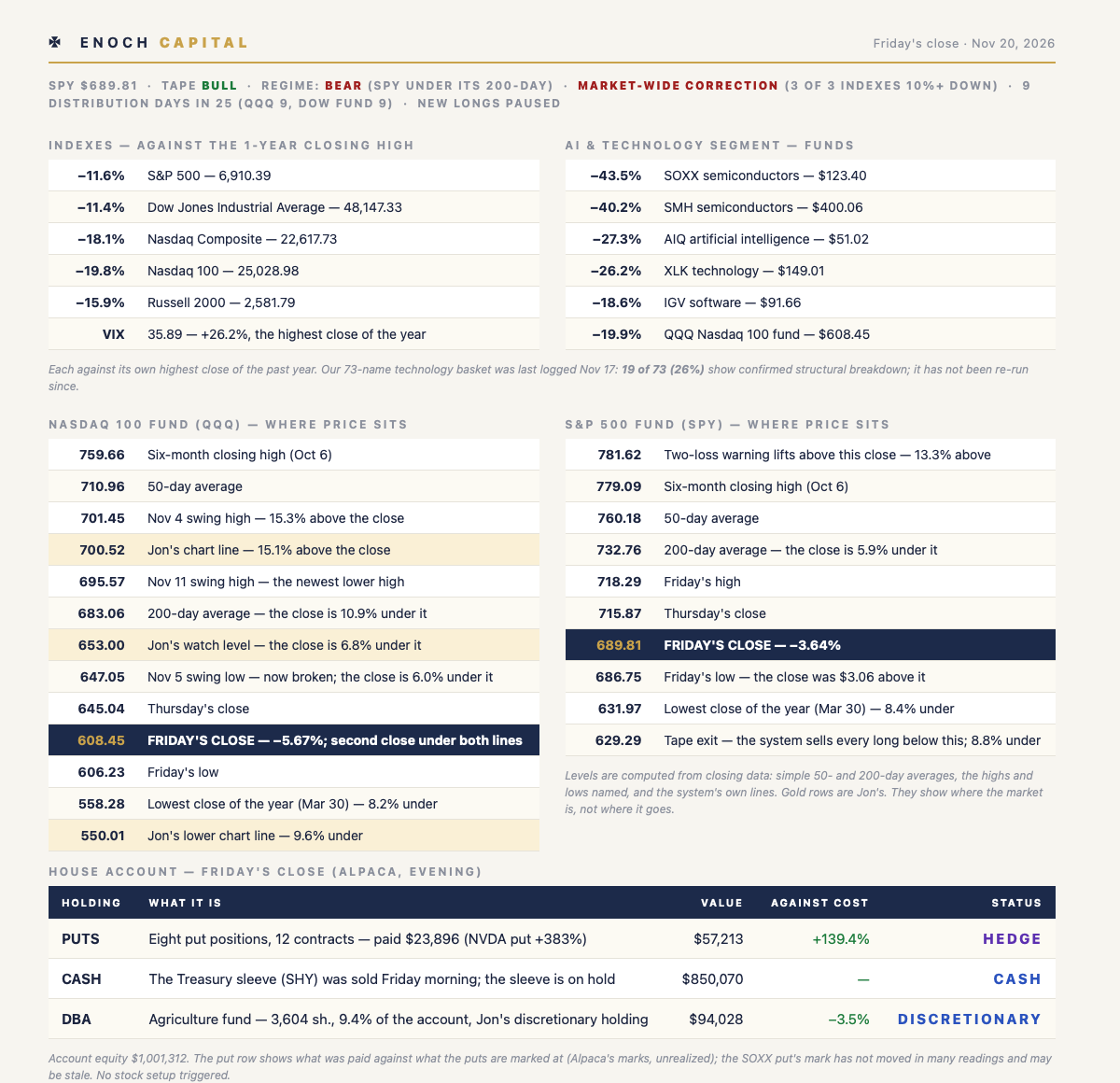
SPY $689.81, −3.64% · Nasdaq 100 fund (QQQ) $608.45, −5.67% · Dow fund (DIA) $481.08, −1.98% · VIX 35.89 · tape BULL, regime: BEAR (SPY under its 200-day average) · by our own standard, a market-wide correction · new longs still paused by the two-loss warning
Friday did not hold a rally this time. The market opened a little lower, the S&P 500 fund (SPY) at $713.56, 0.3% under Thursday's close, and the Nasdaq 100 fund (QQQ) at $638.81, 1.0% under. Then it sold all day. SPY closed at $689.81, $3.06 above its low of $686.75; QQQ at $608.45, $2.22 above its low of $606.23. We have no headline that explains it.
The week. Last Friday, November 13, the S&P 500 fund (SPY) closed at $754.37, the Nasdaq 100 fund (QQQ) at $679.89 and the volatility index at 19.30. This Friday they closed at $689.81, $608.45 and 35.89. Over the five sessions:
→ S&P 500: 7,561.67 to 6,910.39, down 8.6%
→ Dow Jones Industrial Average: 52,347.55 to 48,147.33, down 8.0%
→ Nasdaq Composite: 25,136.27 to 22,617.73, down 10.0%
→ Nasdaq 100: 27,943.74 to 25,028.98, down 10.4%
→ Russell 2000: 2,790.49 to 2,581.79, down 7.5%
→ Volatility index: 19.30 to 35.89, up 86%
SPY closed lower on all five days: Monday −1.9%, Tuesday −1.0%, Wednesday −0.3%, Thursday −2.0% and Friday −3.6%. QQQ fell on four of them; Wednesday it rose 0.4%. By our own count four of the five sessions were distribution days for SPY (Monday, Tuesday, Thursday and Friday; Wednesday's close was down 0.3% but not on higher volume than Tuesday's).
The AI and technology names took the worst of it: the semiconductor funds SMH and SOXX fell 17.8% and 17.4%, the technology fund XLK 12.5%. Nvidia fell 22.9%, Micron 23.6%, Oracle 19.3%, CoreWeave 25.6% and Nebius 29.8%.
The house account went the other way. It closed last Friday at $981,208 and this Friday at $1,001,312, up $20,104, or 2.0%, in a week the Nasdaq 100 fund fell 10.4%. The seven puts we held a week ago were marked at $33,647 against $18,426 paid; the eight we hold now are marked at $57,213 against $23,896 paid, the eighth being the Nebius put we added Friday. The unrealized gain on the puts rose from $15,221 to $33,317. The Invesco DB Agriculture Fund position (DBA) went from $95,686 to $94,028. The rest of the change we have not itemized. The account was not made whole by the puts alone: they are 5.7% of it, and the week's loss in the stocks we did not own is the reason there is a gain to report.
What we did this week: on Tuesday we wrote down the standard for a market-wide correction (the S&P 500, the Nasdaq Composite and the Dow all 10% or more under their highs); on Wednesday we wrote the put rules, including the panic rule; on Thursday the first put setups began to reach the team as IN/OUT emails; on Friday morning we sold the Treasury fund, paused the idle-cash sleeve, and added the Nebius put. By Friday's close the standard was met.
The indexes. Each against its own highest close of the past year, at Friday's close:
→ S&P 500: 6,910.39, down 11.6% from 7,818.93 (October 6); the day, −3.70%
→ Dow Jones Industrial Average: 48,147.33, down 11.4% from 54,349.12 (August 5); −1.93%
→ Nasdaq Composite: 22,617.73, down 18.1% from 27,599.79 (October 6); −5.28%
→ Nasdaq 100: 25,028.98, down 19.8% from 31,224.47 (October 6); −5.61%
→ Russell 2000: 2,581.79, down 15.9% from 3,068.42 (August 14); −2.76%
Is this a correction? On Thursday we said it was not yet. Our own standard, set on November 17, is that a market-wide correction needs the S&P 500, the Nasdaq Composite and the Dow all 10% or more below their highs. Thursday only the Nasdaq Composite was there; the Dow was three-tenths of a point short. Friday all three are over the line: 11.6%, 18.1% and 11.4%. By our standard this is now a market-wide correction. The Nasdaq 100 is two-tenths of a point short of the 20% mark that is the usual convention for a bear market, and we do not call it one.
How it ranks. Against the daily closes back to November 2021, the Nasdaq 100's 5.61% fall is the third-worst day, behind November 5 of this year (−6.36%) and April 4, 2025 (−6.07%). The semiconductor fund SMH fell 10.60%, the second-worst day, behind November 5 (−11.21%). The S&P 500's fall is the seventh-worst and the Dow's the 29th. The volatility index closed at 35.89, up 26.2%, the highest close of the past year.
The level. The Nasdaq 100 fund closed at $608.45, its second close in a row under both Jon's $653 line and the November 5 swing low of $647.05. It is 6.8% under $653 and 6.0% under the swing low, now broken. Its 200-day average is $683.06 (the close is 10.9% under it). Below it are the lowest close of the year, $558.28 on March 30 (8.2% under the close), and Jon's lower chart line of $550.01 (9.6% under).
Distribution days. By our own count the S&P 500 fund, the Nasdaq 100 fund and the Dow fund each have 9 in the last 25 sessions; Friday added one to each, and the October 16 day left the window.
The AI and technology segment. Each fund against its own highest close of the past year, at Friday's close:
→ Semiconductors: SOXX $123.40, down 43.5%; SMH $400.06, down 40.2%
→ Artificial intelligence: AIQ $51.02, down 27.3%
→ Technology: XLK $149.01, down 26.2%; software, IGV $91.66, down 18.6%
→ Nasdaq 100: QQQ $608.45, down 19.9%
The individual names fell with them: Nvidia $125.53 (−14.0% on the day, 47.5% under its high), Micron $594.51 (−13.9%, 51.0% under), Broadcom $304.41 (−12.2%), Oracle $101.19 (−8.5%, 59.2% under), AMD $424.39 (−13.3%), CoreWeave $39.51 (−12.0%, 71.4% under), Nebius $81.31 (−16.1%, 71.6% under) and Intuit $270.44 (−12.8%, 60.0% under).
Where the system stands. Two gauges, and they still disagree. The regime check, SPY against its 200-day average ($732.76), reads bear; SPY closed 5.9% under it. The tape, which is the system's actual exit rule, still reads bull. It turns, and the system sells every long stock position, only on a SPY close below $629.29, 8.8% under Friday's close. New longs wait for a SPY close above $781.62, 13.3% above. The stock scanner found nothing to buy tonight: no long setup fired, 18 names sit within 5% of their pivot, and one candidate would have qualified but for the two-loss warning, which holds new entries until SPY re-proves itself.
The account. The house account closed Friday at $1,001,312, up $11,114 from Thursday's close, in a day the Nasdaq 100 fund fell 5.67%. On Friday morning we sold the Treasury fund the idle-cash sleeve had been in, and the sleeve is on hold. Cash is now $850,070, 85% of the account. Outside the puts it holds one stock position, the Invesco DB Agriculture Fund (DBA): 3,604 shares, $94,028, 9.4% of the account, 3.5% below its cost. The cash is there for the puts: when the market turned bear we set the put budget at 25% of the account, about $250,000, and sold the Treasury fund to fund it. The puts are $57,213 of that so far.
The puts. We hold eight put positions, 12 contracts, for which we paid $23,896. They are marked at $57,213, up 139%. Seven of them were bought on September 29; Nebius was added on Friday morning. By put, in order of gain: Nvidia +383% ($8,385 against $1,735 paid), the QQQ put +279% ($9,668 against $2,551), CoreWeave +203% ($3,710 against $1,225), the four XLK puts +201% ($13,900 against $4,620), Oracle +114% ($2,680 against $1,250), Palantir +92% ($3,470 against $1,805), SOXX +76% ($9,200 against $5,240) and Nebius +13% ($6,200 against $5,470). These are unrealized gains at Alpaca's marks, not prices we sold at. The SOXX mark has not moved in ten readings while the semiconductor fund fell 10.6% on Friday, so it is stale and probably understates the put.
They were bought to stand in for stop orders: a stop can gap through its price, and a put cannot lose more than was paid. We have sold none. Our rule for cashing in on a panic day, written on November 18, needs the Nasdaq 100 fund under $653 and either a 4% one-day drop or a 3% gap. Both are now true. The same check flags the CoreWeave and XLK puts, which are past our 200% take-profit line, and the put book is 5.7% of the account, well inside the 25% budget. We have chosen to hold all of them. That is a judgment, not a rule being followed, and it has a cost we know: these gains are on paper, and a sharp rebound can take back a large part of a put's gain in a day or two. Every threshold in that rule except the 200% line is our own proposal, and when we replayed it on a model of 27 years of QQQ, the panic trigger as written helped in 2020 and 2022 and hurt in 2000-02 and 2008. Nothing tests it on real options history.
The put scan. Friday night's scan of the whole shortable list (about 5,200 names) found 12 stocks that passed every short-side gate, and 6 of them have a put liquid enough to buy: Qualcomm, KLA, Applied Optoelectronics, Ouster, Cisco and Corning. Each is a priced candidate, not an order: at our sizing one contract set costs roughly 0.4% to 0.5% of the account. The other six have no put that passes the liquidity screen. Twenty more sit within 5% above their support, among them Intuit, and a close under it on heavy volume would make each a candidate. Nothing was bought, and the scan places nothing.
Enoch Capital · Chart · Research & Due Diligence
→ Zero management fee. 20% performance only. 10% of that tithed.
Saturday, November 21, markets are closed. The next session is Monday, November 23, 9:30 AM ET. The exchanges are closed Thursday, November 26, for Thanksgiving. The Federal Open Market Committee meets December 8-9.
Through the day verified, per the USCCB daily readings calendar for the United States:
Holy Mary, Mother of God, pray for us.
In Christ,
Jonathan Simmons
Enoch Capital LLC
Catholic Daily goes out Monday through Saturday.
LinkedIn · X @jonenochcap · enochcap.com
Enoch Capital LLC · 2121 S. Broadway, #511, Denver CO 80210
Catholic Daily is an educational publication. It is not investment advice. References to markets, specific securities, or economic conditions are illustrative only and do not constitute recommendations to buy or sell any security. Past performance does not guarantee future results.
Enoch Capital LLC operates under the Publisher's Exemption from the Investment Advisers Act of 1940 (Lowe v. SEC, 472 U.S. 181, 1985). Nothing on this site constitutes the rendering of personalized investment advice. Enoch Capital LLC is not a registered investment adviser.