Good morning.
Friday's Gospel is the cleansing of the temple. The first reading is the Apocalypse again: John is told to take a scroll from an angel and eat it.
Friday of the Thirty-third Week in Ordinary Time
First reading (Apocalypse 10:8-11): A voice from heaven tells John to take the open scroll from the hand of the angel who stands on the sea and on the land. The angel says: "Take the book, and eat it up: and it shall make thy belly bitter, but in thy mouth it shall be sweet as honey." John eats it, and it is sweet in his mouth and bitter in his stomach. Then he is told: "Thou must prophesy again to many nations, and peoples, and tongues, and kings." The Responsorial refrain answers the sweetness: "How sweet to my taste is your promise!" The psalm sings that the law of the Lord is better than gold: "The law of thy mouth is good to me, above thousands of gold and silver" (Psalm 118:72, in the Douay-Rheims numbering).
The Gospel (Luke 19:45-48): "And entering into the temple, he began to cast out them that sold therein, and them that bought. Saying to them: It is written: My house is the house of prayer. But you have made it a den of thieves." He taught there every day. The chief priests, the scribes and the rulers of the people wanted to destroy Him, "and they found not what to do to him: for all the people were very attentive to hear him."
The full readings are on USCCB.org.
bible.usccb.org/bible/readings/112026.cfm →
Gregory begins with the order of events. Jesus had just foretold the ruin of the city, and "He straightway entered the temple, that He might cast out them that bought and sold in it. Showing that the destruction of the people arose chiefly from the guilt of the priests."
Cyril takes up what was being sold: "Now there were in the temple a number of sellers who sold animals, by the custom of the law, for the sacrificial victims, but the time was now come for the shadows to pass away, and the truth of Christ to shine forth." The trade was lawful. What changed was that the One it pointed to had come, and the house was to be "a house of prayer." Ambrose draws the line from the other side: God "wishes not His temple to be a house of traffic, but the dwelling-place of holiness, nor does He fix the priestly service in a salable performance of religion."
Theophylact notes that this was the second time: He did the same thing at the beginning of His preaching, "and now He did it a second time, because the crime of the Jews was much increased by their not having been chastened by the former warning."
Gregory, on the sellers and the buyers: "to sell justice is to observe it on condition of receiving a reward." And the buyers are those who, "unwilling to discharge what is just to their neighbor," pay a price to their patrons and so "purchase sin." Origen puts it most plainly of himself: "If any then sells, let him be cast out" — if I teach what the Holy Spirit gave me only for money, "what else do I but sell a dove, that is, the Holy Spirit?"
And Gregory's last word on the passage: when the soul is wisely instructed to shun evil, "truth teaches daily in the temple."
A reading of our own, not a Father's. The passage does not condemn buying and selling; Cyril says the sellers were doing what the law allowed. It marks where trade belongs and what may never be put up for sale. For anyone who works with money, the line Gregory draws is the useful one: a thing that is owed, such as justice, honest weights, or a fair account of the risk, is not a product. We try to hold our own work to it: the readings, the market section and the account figures below are given free, with the risks stated as they are.
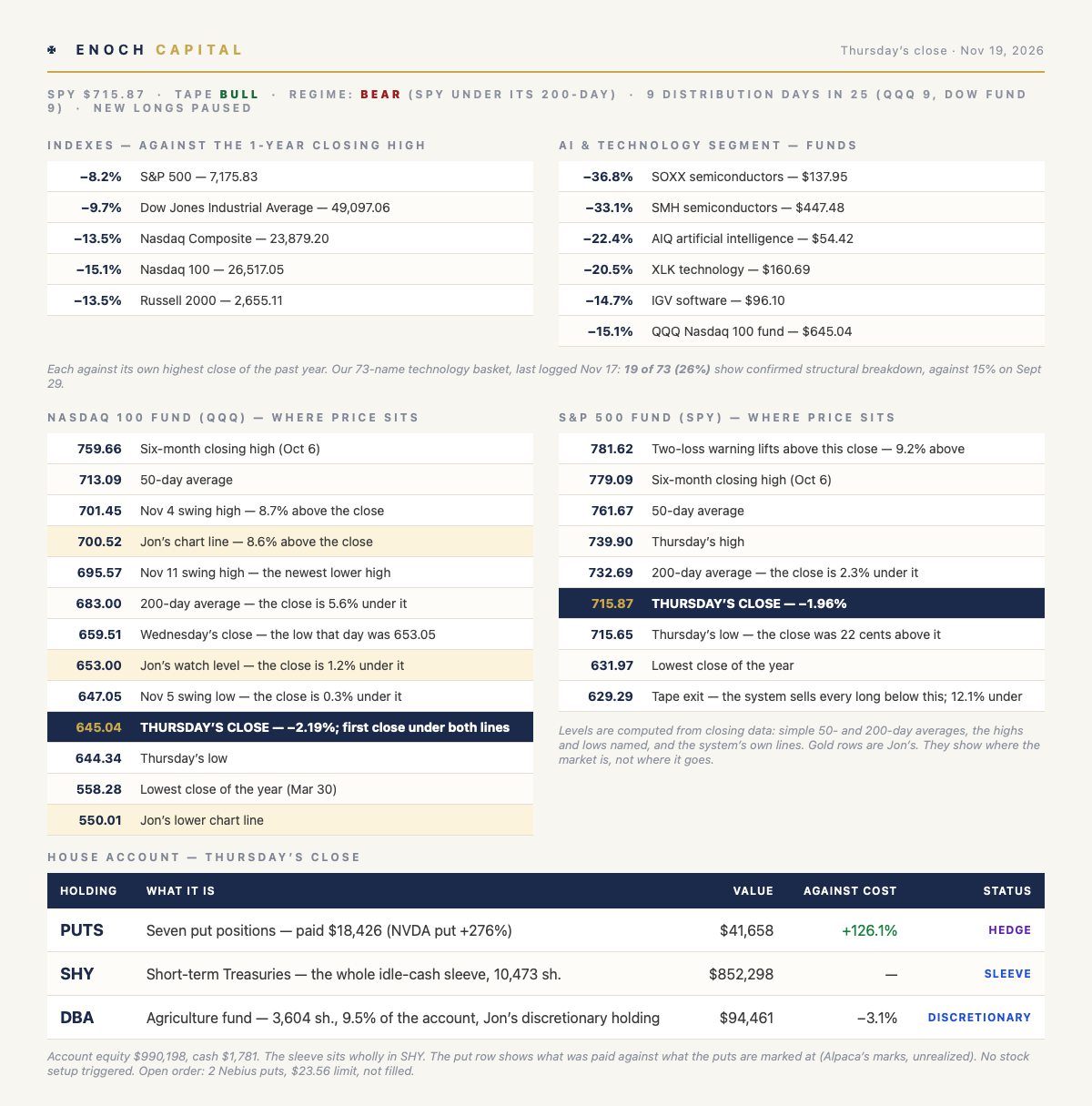
SPY $715.87, −1.96% · Nasdaq 100 fund (QQQ) $645.04, −2.19% · Dow fund (DIA) $490.79, −2.18% · VIX 28.44 · tape BULL, regime: BEAR (SPY under its 200-day average, a second close in a row) · new longs still paused by the two-loss warning
The gap up did not hold. Futures had pointed to a higher open, and the market opened higher: the S&P 500 fund (SPY) at $737.46, 1.0% above Wednesday's close, and the Nasdaq 100 fund (QQQ) at $671.05, 1.7% above. Then it sold all day. SPY closed at $715.87, within 22 cents of its low of the day ($715.65), and QQQ at $645.04, 3.9% under where it opened. Every index we follow fell about 2%. We have no headline that explains it.
The indexes. Each against its own highest close of the past year, at Thursday's close:
→ S&P 500: 7,175.83, down 8.2% from 7,818.93 (October 6)
→ Dow Jones Industrial Average: 49,097.06, down 9.7% from 54,349.12 (August 5)
→ Nasdaq Composite: 23,879.20, down 13.5% from 27,599.79 (October 6)
→ Nasdaq 100: 26,517.05, down 15.1% from 31,224.47 (October 6)
→ Russell 2000: 2,655.11, down 13.5% from 3,068.42 (August 14)
Is this a correction? Our own standard, set on November 17, is that a market-wide correction needs the S&P 500, the Nasdaq Composite and the Dow all 10% or more below their highs. Only the Nasdaq Composite is there. The Dow is 9.7% down, three-tenths of a point short; the S&P 500 is 8.2%. So we do not call the market as a whole in a correction. We do say that the Nasdaq Composite, the Nasdaq 100 and the Russell 2000 are each 13% to 15% down.
The level. On Wednesday the Nasdaq 100 fund's low was $653.05, five cents above the $653 line Jon has been watching. Thursday it traded as low as $644.34 and closed at $645.04. That is the first close under both $653 and the November 5 swing low of $647.05. Its swing highs are unchanged, five in a row, each lower than the last: $762.86, $727.95, $726.14, $701.45 and $695.57. Its 200-day average is $683.00, 5.9% above the close, and its 50-day average is $713.09.
Distribution days. By our own count the S&P 500 fund, the Nasdaq 100 fund and the Dow fund each have 9 in the last 25 sessions, up from 8; Thursday added one to each. The October 16 day leaves the window with Friday's session.
The AI and technology segment. Each fund against its own highest close of the past year, at Thursday's close:
→ Semiconductors: SMH $447.48, down 33.1%; SOXX $137.95, down 36.8%
→ Artificial intelligence: AIQ $54.42, down 22.4%
→ Technology: XLK $160.69, down 20.5%; software, IGV $96.10, down 14.7%
→ Nasdaq 100: QQQ $645.04, down 15.1%
The individual names fell with them: Nvidia $145.98 (−3.3% on the day, 39.0% under its high), Micron $690.44 (43.1% under), Broadcom $346.65 (28.0%), Oracle $110.57 (55.4%), AMD $489.19 (−7.7% on the day), CoreWeave $44.91 (−6.1%, 67.5% under), Nebius $96.92 (−9.4%, 66.2% under) and Intuit $310.02 (54.2% under).
Where the system stands. Two gauges, and they disagree. The regime check, SPY against its 200-day average ($732.69), reads bear: SPY closed 2.3% under it for the second day. The tape, which is the system's actual exit rule, still reads bull. It turns, and the system sells every long stock position, only on a SPY close below $629.29, 12.1% under Thursday's close. New longs wait for a SPY close above $781.62, 9.2% above. The system holds no long stock other than the agriculture fund, and the stock scanner found nothing to buy tonight.
The account. The house account closed Thursday at $990,198, with $1,781 in cash, up $4,128 from Wednesday's close. The idle-cash sleeve is wholly in SHY, the short-term Treasury fund: 10,473 shares, $852,298. Outside the sleeve it holds one stock position, the Invesco DB Agriculture Fund (DBA): 3,604 shares, $94,461, 9.5% of the account, 3.1% below its cost.
The puts. We bought seven put positions on September 29, ten contracts in all, for $18,426. They are marked at $41,658, up 126%, and they added $3,015 on Thursday. By put, in order of gain: Nvidia +276% ($6,530 against $1,735 paid), the QQQ put +174% ($6,983 against $2,551), CoreWeave +171% ($3,315 against $1,225), the four XLK puts +133% ($10,780 against $4,620), SOXX +76% ($9,200 against $5,240), Oracle +67% ($2,085 against $1,250) and Palantir +53% ($2,765 against $1,805). These are unrealized gains at Alpaca's marks, not prices we sold at, and the SOXX mark has not moved in nine readings, so it may be a stale quote.
They were bought to stand in for stop orders: a stop can gap through its price, and a put cannot lose more than was paid. We have sold none. Our rule for cashing in on a panic day needs the Nasdaq-100 fund under $653 and either a 4% one-day drop or a 3% gap; the fund is under $653, but it fell 2.2%, so the rule did not fire. The put book is 4.21% of the account against a 4.0% limit we set, and the XLK puts are flagged to be trimmed by about 8%; the Nvidia put is past our 200% take-profit line and is kept on purpose. None of these thresholds has been validated against real options history.
New puts, and how we are asking about them. The scanner now looks for puts every night across the whole list of 5,205 names, skipping any stock under $10 or trading under 250,000 shares a day. Thursday night five stocks passed every gate: Nebius (NBIS), Dave (DAVE), AAUC, CMP and Globe Life (GL). Only Nebius has a put that passes our liquidity screen: the $90 strike expiring June 17, 2027, about 7% under the price, at roughly $23.55 a share; two contracts are $4,712, 0.48% of the account, and that is the most they can lose. The other four have no put that passes. Nebius fell 9.4% on Thursday, and it was within 1% of its support on Wednesday. We placed the order for two contracts at a limit of $23.56 after the close; it is working and has not filled.
A put setup now comes to us the way a stock setup does, as one email with an IN and an OUT button, and clicking IN places the order in that person's own account. The premium is paid by selling a little of the Treasury sleeve, so the account is not left short of cash. We also set a budget for puts as a share of the account: 4% while the tape reads bull, as it does now, and 25% if the tape turns, with each put sized to a fraction of it. Those proportions are our proposals, and nothing tests a put book that large; a put book of 25% of an account can lose all of it if the market rebounds.
Thirty-three more stocks are within 5% above their support with every structural gate passed. The closest are Madrigal (MDGL, 0.1%), AST SpaceMobile (ASTS, 0.2%) and Everspin (MRAM, 0.3%). Among the technology funds, AIQ, XLK, QQQ and SMH are now each under their three-month support, by 2.5%, 1.0%, 0.3% and 0.1%; IGV is 0.4% above and SOXX 4.6% above.
Enoch Capital · Chart · Research & Due Diligence
→ Zero management fee. 20% performance only. 10% of that tithed.
Friday, November 20, is an ordinary trading day: stocks and exchange-traded funds trade 9:30 AM to 4:00 PM ET. It is also the monthly options expiration, the third Friday of the month. Intuit and Ross Stores reported after Thursday's close; we have not read their results. The Federal Open Market Committee meets December 8-9.
The week ahead, per the USCCB daily readings calendar for the United States:
Holy Mary, Mother of God, pray for us.
In Christ,
Jonathan Simmons
Enoch Capital LLC
Catholic Daily goes out Monday through Saturday.
LinkedIn · X @jonenochcap · enochcap.com
Enoch Capital LLC · 2121 S. Broadway, #511, Denver CO 80210
Catholic Daily is an educational publication. It is not investment advice. References to markets, specific securities, or economic conditions are illustrative only and do not constitute recommendations to buy or sell any security. Past performance does not guarantee future results.
Enoch Capital LLC operates under the Publisher's Exemption from the Investment Advisers Act of 1940 (Lowe v. SEC, 472 U.S. 181, 1985). Nothing on this site constitutes the rendering of personalized investment advice. Enoch Capital LLC is not a registered investment adviser.