Good morning.
The Church keeps the memorial of St. Frances Xavier Cabrini today. The first reading is two verses of love from the apostle John, and the Gospel is the Lord's warning about the days of Noe.
Memorial of Saint Frances Xavier Cabrini, Virgin
First reading (2 John 4-9): "I was exceeding glad, that I found of thy children walking in truth, as we have received a commandment from the Father. And now I beseech thee, lady, not as writing a new commandment to thee, but that which we have had from the beginning, that we love one another. And this is charity, that we walk according to his commandments." Then the warning (verses 8-9): "Look to yourselves, that you lose not the things which you have wrought: but that you may receive a full reward. Whosoever revolteth, and continueth not in the doctrine of Christ, hath not God. He that continueth in the doctrine, the same hath both the Father and the Son."
The Gospel (Luke 17:26-37): "And as it came to pass in the days of Noe, so shall it be also in the days of the Son of man. They did eat and drink, they married wives, and were given in marriage, until the day that Noe entered into the ark: and the flood came and destroyed them all. Likewise as it came to pass, in the days of Lot: they did eat and drink, they bought and sold, they planted and built." Then (verse 33): "Whosoever shall seek to save his life, shall lose it: and whosoever shall lose it, shall preserve it." The Vulgate has it: "Quicumque quaesierit animam suam salvam facere, perdet illam : et quicumque perdiderit illam, vivificabit eam."
Both readings are about what a person holds on to. John asks that nothing the community has wrought be lost, and the Lord says the one who holds his life tightly is the one who loses it.
The full readings are on USCCB.org.
bible.usccb.org/bible/readings/111326.cfm →
Aquinas assembled the Catena Aurea from the Fathers, verse by verse, and the passage on Noe and Lot gives a plain answer to a plain question: what was wrong with eating and drinking, buying and selling, planting and building?
Chrysostom, in the Catena, says the unbelief of those people "proceeded from self-indulgence, and softness of mind." Ambrose is the one to read slowly: "Let it not however be supposed that marriages, or again meat and drink, are condemned, seeing that by the one succession is sustained, by the other nature, but moderation is to be sought for in all things. For whatsoever is more than this is of evil." And Bede points at the same thing from the other side: the Lord passes over the worst of Sodom and names only what might seem "trifling offenses, or none at all," so that "you may understand how fearfully unlawful pleasures are punished, when lawful pleasures taken to excess receive for their reward fire and brimstone."
Eusebius adds a detail that is easy to miss. The fire did not fall on Sodom before Lot had gone out, "just as the deluge did not swallow up the inhabitants of the earth before that Noah entered the ark." He reads it to mean that as long as the righteous dwelt among the wicked, God suspended His anger.
The Catechism (1809) names the virtue Ambrose is describing: "Temperance is the moral virtue that moderates the attraction of pleasures and provides balance in the use of created goods. It ensures the will's mastery over instincts and keeps desires within the limits of what is honorable." It cites the Old Testament: "Do not follow your base desires, but restrain your appetites."
Nothing on the list in Luke is a sin by itself. People eat, marry, buy, sell, plant and build in every age, and the Fathers do not ask anyone to stop. They ask that none of it be the whole of a life.
The facts below are from Franciscan Media's entry for her day. She was born on July 15, 1850. The entry says that when a bishop closed an orphanage in 1880, he "named Frances prioress of the Missionary Sisters of the Sacred Heart," and that "at the urging of Pope Leo XIII, Frances went west instead of east," traveling with six sisters to New York City.
She died on December 22, 1917, in Chicago, at her own Columbus Hospital, of malaria. She was the first United States citizen to be canonized, and the Church names her patron of hospital administrators, immigrants, and impossible causes.
Her day falls on the reading from John, "Look to yourselves, that you lose not the things which you have wrought," and the Gospel's "Whosoever shall lose it, shall preserve it." She was sent west instead of east, and the Church keeps her as the patron of immigrants.
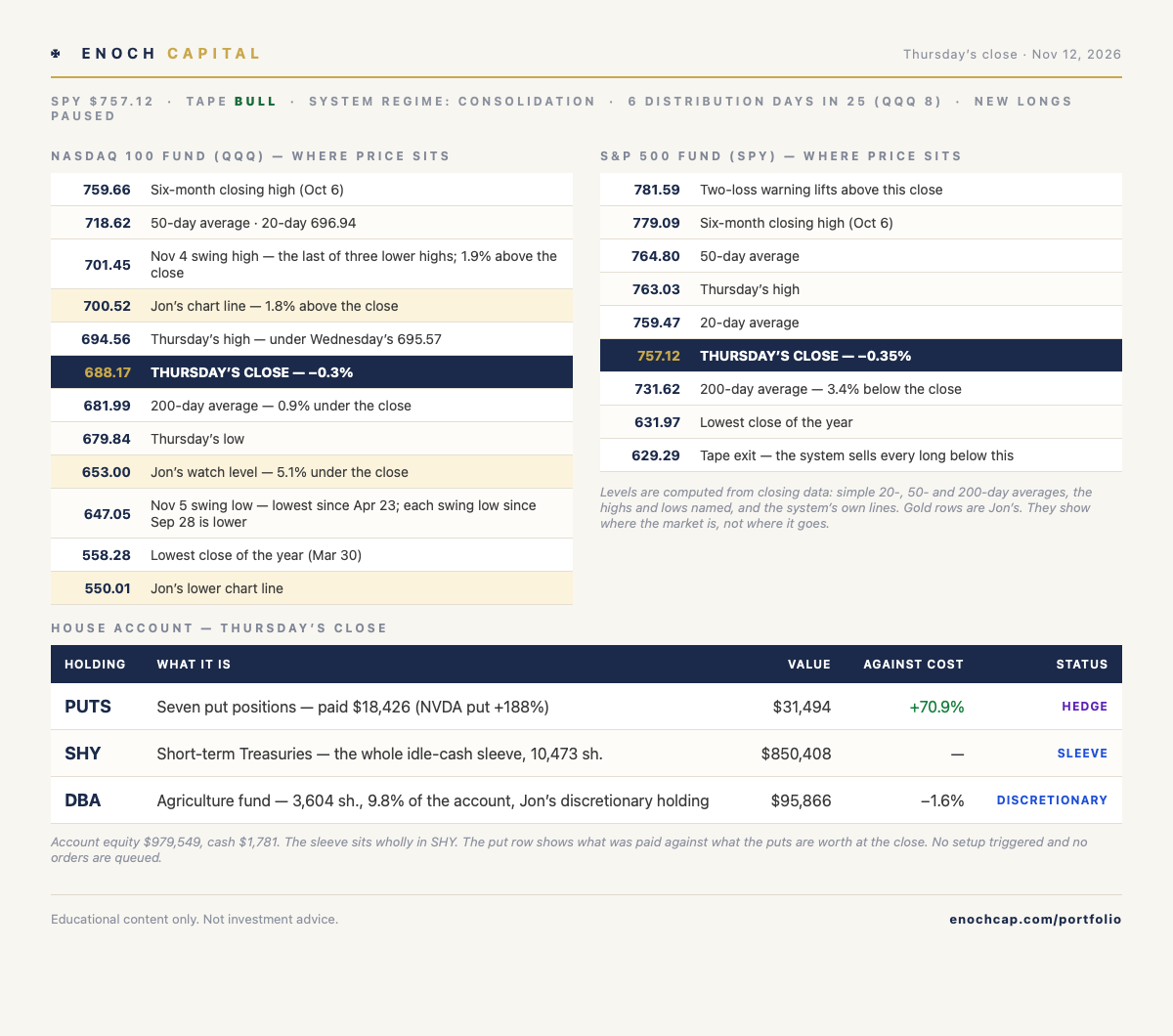
SPY $757.12, −0.35% · Nasdaq 100 fund (QQQ) $688.17, −0.32% · VIX 18.70 · tape BULL, system regime: consolidation · new longs still paused by the two-loss warning
The Nasdaq 100 fund closed at $688.17, down 0.3% from $690.38, after opening at $680.21 and trading between $679.84 and $694.56. The S&P 500 fund closed at $757.12, down 0.35% from $759.81, in a range of $753.70 to $763.03; it opened at $753.98. The VIX rose from 17.49 to 18.70.
At about 6:40 AM ET Friday, S&P 500 futures were at 7,628, up 0.17% from Thursday's settlement of 7,615.25, and Nasdaq 100 futures at 28,401, up 0.06% from 28,384.50.
By our own count Thursday adds no distribution day. October 8 left the window with Thursday's session, so the S&P 500 fund now has 6 in the last 25 sessions (it had 7) and the Nasdaq 100 fund 8 (it had 9). QQQ's October 12 leaves the window with Monday's session, its October 13 with Tuesday's, and October 14, for both funds, with Wednesday's.
The swings. Thursday did not change the structure. The Nasdaq 100 fund's high of $694.56 stayed under Wednesday's $695.57 and under the November 4 swing high of $701.45, and its low of $679.84 stayed above the November 5 swing low of $647.05. No new swing point is confirmed, since a swing needs three bars on each side. The sequence from last week stands: swing highs of $762.86, $727.95, $726.14 and $701.45, each lower than the one before, and swing lows of $731.63, $707.23, $701.16 and $647.05, each lower too. The fund closed 0.9% above its 200-day average ($681.99), but traded below it during the session, down to $679.84.
NVIDIA. NVDA opened at $150.99, 13.1% under Wednesday's close of $173.73, traded as low as $148.80, and closed at $166.19, down 4.3%. The press explains the gap: after Wednesday's close, Benzinga and others reported, citing Bloomberg, that Nvidia's board was considering removing its chief executive, Jensen Huang, amid reported allegations about the company's China dealings, and Friday's headlines refer to his exit and to a Department of Justice probe. These are press reports, not Nvidia filings, and we have not checked them against the company's own statements. Since the November 3 close of $206.69 the stock is down 19.6%, and it is under both its 50-day average ($215.96) and its 200-day average ($204.34). The account holds no NVDA shares; it holds one NVDA put.
CoreWeave. The stock closed at $56.60, down 6.9% from $60.77, after Wednesday's gain of 24.7% on its report. The account's CoreWeave put, a $77.50 strike expiring March 19, 2027, closed at $2,525 against $2,235 on Wednesday and $1,225 paid.
Where price sits. Levels are computed from closing data. We name them so the reader can see where the market is, not to say where it will go.
Nasdaq 100 fund (QQQ), closed at $688.17:
→ $759.66, the six-month closing high (October 6), 10.4% above the close; the 50-day average is $718.62 and the 20-day $696.94
→ $701.45, the November 4 swing high, the last of the lower highs, 1.9% above the close
→ $700.52, Jon's upper chart line, 1.8% above Thursday's close
→ $694.56, Thursday's high, and $680.21, the open
→ $681.99, the 200-day average, 0.9% under the close
→ $653, the level Jon has been watching, 5.1% under the close
→ $647.05, the November 5 swing low, the lowest since April 23, 6.0% under the close
→ $558.28, the lowest close of the past year (March 30); Jon's lower chart line, $550.01, is 1.5% under it and 20.1% under Thursday's close
S&P 500 fund (SPY), closed at $757.12:
→ $781.59, the close above which the two-loss warning lifts and the system can take new longs, 3.2% above Thursday's close
→ $779.09, the six-month closing high (October 6); the 50-day average is $764.80 and the 20-day $759.47
→ $731.62, the 200-day average, 3.4% under the close
→ $631.97, the lowest close of the past year, and $629.29, the line the system's tape exit uses; the tape turns, and the system sells every long, only on a SPY close below it. It would take a fall of 16.9% from Thursday's close to reach it.
Where Jon thinks it goes. Jon's view is in the lines: his read is that the market will still correct, and that a lower trend in the Nasdaq 100 fund may already have started. What would not fit it is a trade above $701.45 and then a pullback that holds above $647.05, a higher high and a higher low. Neither has happened. A fall through $647.05 would extend the sequence of lower lows. These are his marks, drawn on a chart, and we hold them as we hold any prophecy: it is not true until it happens.
The account. The house account closed Thursday at $979,549, with $1,781 in cash. The idle-cash sleeve is wholly in SHY, the short-term Treasury fund: 10,473 shares, $850,408. Outside the sleeve it holds one stock position, the Invesco DB Agriculture Fund (DBA): 3,604 shares, $95,866, 9.8% of the account, 1.6% below its cost. The seven put positions, ten contracts in all, cost $18,426 and closed at $31,494, up 71%.
Compared with the same reading on Wednesday ($978,019), the account is up $1,531: the puts gained $1,404 on a day the Nasdaq 100 fund fell 0.3%, DBA $865, and SHY gave back $738. The NVDA put, a $210 strike expiring June 17, 2027, closed at $5,005 against $1,735 paid. The others: the QQQ put $4,109 against $2,551 paid, the four XLK puts $7,380 against $4,620, SOXX $9,200 against $5,240, CoreWeave $2,525 against $1,225, Oracle $1,360 against $1,250, and Palantir $1,915 against $1,805. Alpaca's own day change reads +$8,201, which is its figure against its stored Wednesday equity of $971,349; that stored figure is $6,670 below our Wednesday reading, and we have not resolved which is right. The $1,531 compares like with like.
The system takes no new long until SPY closes above $781.59. The scanner's list holds thirty-four names at or near their 52-week pivots, and none triggered. No orders were placed, and none are queued for Friday's open.
Enoch Capital · Chart · Research & Due Diligence
→ Zero management fee. 20% performance only. 10% of that tithed.
Friday, November 13, is an ordinary trading day: stocks and exchange-traded funds trade 9:30 AM to 4:00 PM ET. The Producer Price Index for October is due at 8:30 AM ET. The Federal Open Market Committee meets December 8-9.
The week ahead, per the USCCB daily readings calendar for the United States:
Saint Frances Xavier Cabrini, pray for us.
In Christ,
Jonathan Simmons
Enoch Capital LLC
Catholic Daily goes out Monday through Saturday.
LinkedIn · X @jonenochcap · enochcap.com
Enoch Capital LLC · 2121 S. Broadway, #511, Denver CO 80210
Catholic Daily is an educational publication. It is not investment advice. References to markets, specific securities, or economic conditions are illustrative only and do not constitute recommendations to buy or sell any security. Past performance does not guarantee future results.
Enoch Capital LLC operates under the Publisher's Exemption from the Investment Advisers Act of 1940 (Lowe v. SEC, 472 U.S. 181, 1985). Nothing on this site constitutes the rendering of personalized investment advice. Enoch Capital LLC is not a registered investment adviser.