Good morning.
The Church keeps the memorial of St. Josaphat today, a bishop who would not leave his city, and the first reading is a short letter Paul wrote from prison about a man who had run away.
Memorial of Saint Josaphat, Bishop and Martyr
First reading (Philemon 7-20): Paul writes to Philemon about Onesimus, "my son, whom I have begotten in my bands." Then: "Who hath been heretofore unprofitable to thee, but now is profitable both to me and thee, Whom I have sent back to thee. And do thou receive him as my own bowels." And the verses at the center of the letter (15-16): "For perhaps he therefore departed for a season from thee, that thou mightest receive him again for ever: Not now as a servant, but instead of a servant, a most dear brother, especially to me: but how much more to thee both in the flesh and in the Lord?" The Vulgate has it: "jam non ut servum, sed pro servo carissimum fratrem."
Paul does not command it. He says he could, and asks instead (verse 14): "But without thy counsel I would do nothing: that thy good deed might not be as it were of necessity, but voluntary." And he puts his own name under the debt (verses 18-19): "And if he hath wronged thee in any thing, or is in thy debt, put that to my account. I Paul have written it with my own hand: I will repay it."
The Gospel (Luke 17:20-25) is the Pharisees' question about when the kingdom will come: "The kingdom of God cometh not with observation: Neither shall they say, Behold here, or behold there. For lo, the kingdom of God is within you." Then, to the disciples: "For as the lightning that lighteneth from under heaven, shineth unto the parts that are under heaven, so shall the Son of man be in his day. But first he must suffer many things, and be rejected by this generation." The Vulgate for verse 21: "Ecce enim regnum Dei intra vos est."
The Catena Aurea gathers what the Fathers made of "within you." Cyril: "it rests with you and your own hearts to receive it." Gregory of Nyssa takes it to mean "that joy that is implanted in our hearts by the Holy Spirit." And Bede: "reigning in their hearts by faith."
Both readings turn on where a thing is received. Philemon is asked to receive a man back in the Lord, and the Pharisees are told the kingdom is received in the heart before it is seen anywhere. Neither can be forced, and Paul says so about his own request.
The full readings are on USCCB.org.
bible.usccb.org/bible/readings/111226.cfm →
Josaphat was born at Volodymyr, in Volhynia, in 1580 or, by some accounts, 1584. His father was a merchant and a town councilor, and the boy was apprenticed to a merchant at Vilna. The Catholic Encyclopedia says that at school he learned almost the entire breviary and from then on read it daily. The merchant came to value him so much that he offered Josaphat his whole fortune and his daughter's hand. Josaphat declined, and in 1604, at twenty-four, he entered the Basilian monastery of the Holy Trinity at Vilna.
He was ordained a priest in 1609. On November 12, 1617, reluctantly, he was consecrated Bishop of Vitebsk, with the right of succession to Polotsk, and in 1618 he became archbishop. The Church he served had been divided since the Union of Berest in 1596 into two parties, and the Encyclopedia says that as bishop he restored churches, issued a catechism to his clergy with instructions that it be learned by heart, assembled synods, and preached "in the fields, hospitals, prisons, and even on his journeys." It adds that his "extraordinary love for the poor" won many to the Catholic faith.
On November 12, 1623, in Vitebsk, he was killed. The Encyclopedia gives it in one line: "an axe-stroke and a bullet." It also says he "awaited death with a certain yearning, refusing to avail himself of the opportunity of flight afforded him." Urban VIII began the inquiry into his cause in 1628, and in 1643, twenty years after his death, he was beatified. The Encyclopedia notes that five years after his death his body was still incorrupt. He was canonized in 1867.
Christians in that part of the world are still divided, and the Catechism (820) says what the Church owes that division: "Christ always gives his Church the gift of unity, but the Church must always pray and work to maintain, reinforce, and perfect the unity that Christ wills for her." It cites the Lord's own prayer at his Passion: "That they may all be one." The memorial is a good day to pray it.
The Catechism uses Paul's letter where it speaks about enslavement (2414). The seventh commandment, it says, "forbids acts or enterprises that for any reason — selfish or ideological, commercial, or totalitarian — lead to the enslavement of human beings, to their being bought, sold and exchanged like merchandise, in disregard for their personal dignity." And then the sentence that names the root: "It is a sin against the dignity of persons and their fundamental rights to reduce them by violence to their productive value or to a source of profit." The paragraph ends with Paul asking Philemon to treat Onesimus "no longer as a slave but more than a slave, as a beloved brother, . . . both in the flesh and in the Lord."
Paul grants that Onesimus had been "unprofitable" to Philemon and says he is now "profitable" to both of them, and then spends the rest of the letter on something else: a brother, and a debt that Paul takes on himself. The Catechism (1935) states the principle behind it: "The equality of men rests essentially on their dignity as persons and the rights that flow from it."
Every ledger counts what a person produces. In the letter to Philemon the ledger is open on the table, the debt is written in Paul's own hand, and the man it concerns is called a brother.
SPY $759.81, +1.3% · Nasdaq 100 fund (QQQ) $690.38, +2.3% · VIX 17.49 · tape BULL, system regime: consolidation · new longs still paused by the two-loss warning
The Nasdaq 100 fund closed at $690.38, up 2.3% from $674.76, after opening at $687.28 and trading between $683.60 and $695.57. The S&P 500 fund closed at $759.81, up 1.3% from $749.92, in a range of $754.91 to $762.51; it opened at $756.80. The VIX fell from 19.46 to 17.49.
By our own count Wednesday adds no distribution day, because both funds rose. The S&P 500 fund still has 7 in the last 25 sessions and the Nasdaq 100 fund 9. The oldest of each, October 8, leaves the window with Thursday's session, and a Thursday decline on higher volume could add one back.
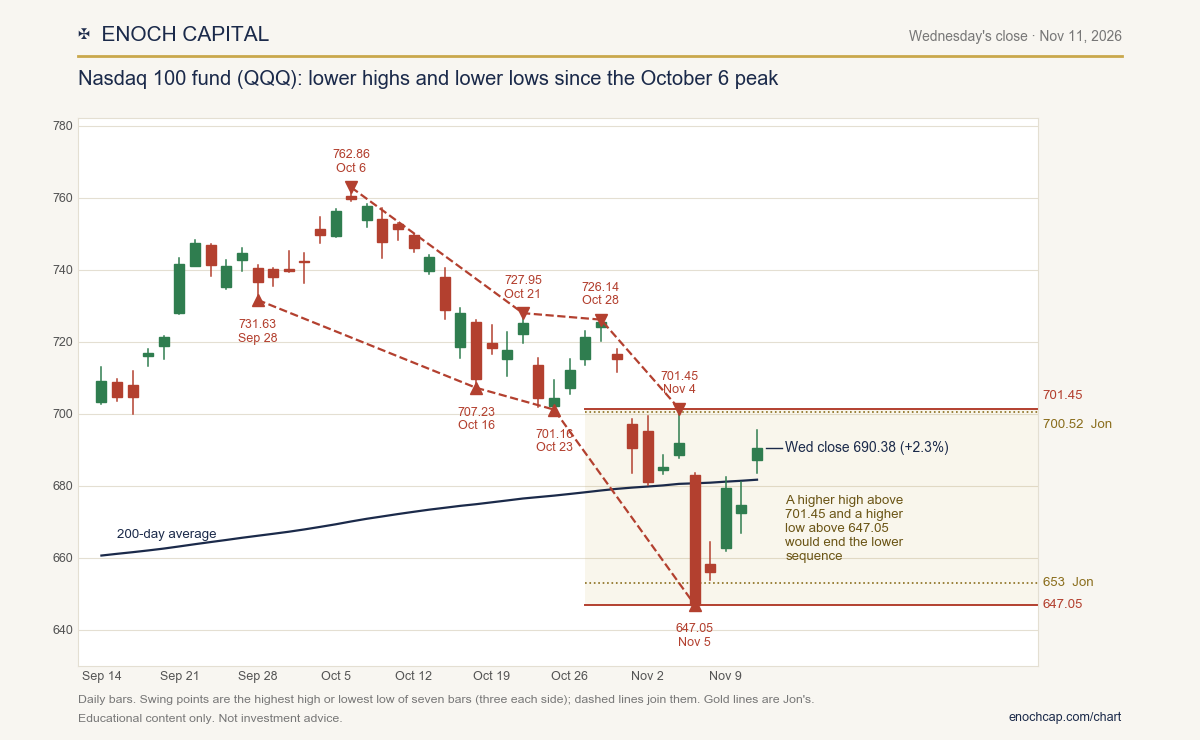
The swings. Jon's read of the Nasdaq 100 fund is that a lower trend has started, and the swing points, computed here from daily highs and lows with three bars on each side, bear him out. Each swing high since the October 6 peak is lower: $762.86 on October 6, $727.95 on October 21, $726.14 on October 28, $701.45 on November 4. Each swing low is lower too: $731.63 on September 28, $707.23 on October 16, $701.16 on October 23, $647.05 on November 5, the lowest print since April 23. Wednesday's rally to a high of $695.57 stopped $5.88 under the November 4 swing high, so it has not made a higher high. The 200-day average ($681.71) sits inside this: the fund closed 1.3% above it Wednesday, its first close above since November 4, and the next day it fell 6.5%. The S&P 500 fund shows lower swing lows ($760.64, $758.68, $750.36, $732.71) but its November 4 swing high ($775.64) is above October 28's ($773.36), so its structure is less clear. The system's tape reads the S&P 500 fund on a slower measure and still reads bull.
CoreWeave. The company reported after Tuesday's close, and its stock closed at $60.77, up 24.7% from $48.73. The figures below are from press reports (CNBC and The Motley Fool), not from the company's release or its filing. Revenue for the third quarter was $3.66 billion, up 168% from a year earlier, and the backlog $132.5 billion. The company raised its 2026 revenue forecast to $13.0-13.3 billion, with capital spending of $37-39 billion and debt of about $47 billion. It paid $846 million in interest in the quarter and guided to $1.05-1.15 billion for the fourth. CNBC reports the shares had been off almost 65% from their 52-week high on worries about borrowing, and that many analysts left their ratings and price targets unchanged after the report. The account holds one CoreWeave put, a $77.50 strike expiring March 19, 2027. It closed at $2,235 against $3,035 on Tuesday and $1,225 paid.
NVIDIA. NVDA closed at $173.73, up 2.9%. Since the November 3 close of $206.69 it is down 15.9%. It is under both its 50-day average ($217.12) and its 200-day average ($204.47). The account holds no NVDA shares; it holds one NVDA put.
Where price sits. Levels are computed from closing data. We name them so the reader can see where the market is, not to say where it will go.
Nasdaq 100 fund (QQQ), closed at $690.38:
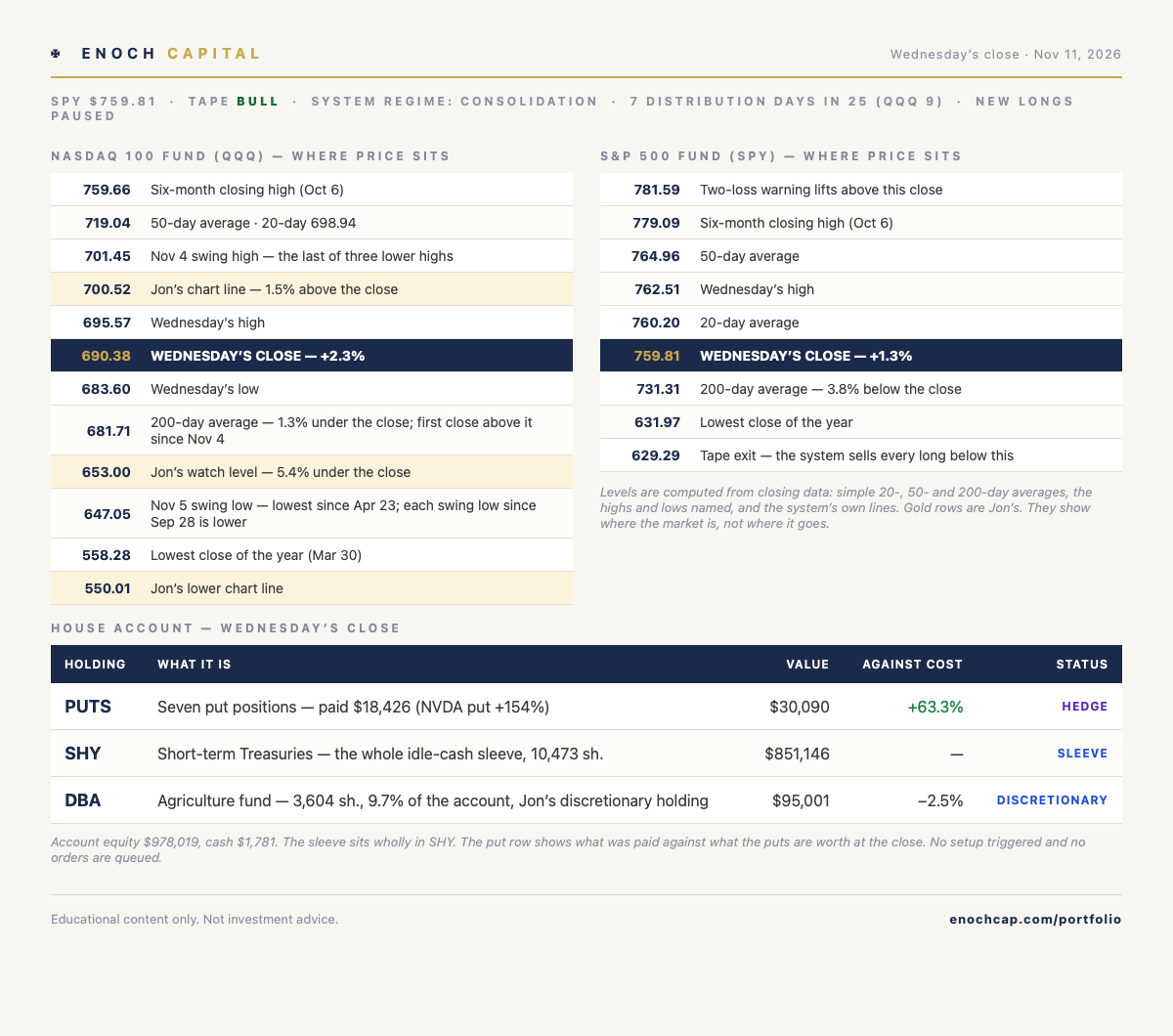
→ $759.66, the six-month closing high (October 6), 10.0% above the close; the 50-day average is $719.04 and the 20-day $698.94
→ $701.45, the November 4 swing high, the last of the lower highs, 1.6% above the close
→ $700.52, Jon's upper chart line, 1.5% above Wednesday's close
→ $695.57, Wednesday's high, and $687.28, the open
→ $681.71, the 200-day average, 1.3% under the close
→ $653, the level Jon has been watching, 5.4% under the close
→ $647.05, the November 5 swing low, the lowest since April 23, 6.3% under the close
→ $558.28, the lowest close of the past year (March 30); Jon's lower chart line, $550.01, is 1.5% under it and 20.3% under Wednesday's close
S&P 500 fund (SPY), closed at $759.81:
→ $781.59, the close above which the two-loss warning lifts and the system can take new longs, 2.9% above Wednesday's close
→ $779.09, the six-month closing high (October 6); the 50-day average is $764.96 and the 20-day $760.20
→ $731.31, the 200-day average, 3.8% under the close
→ $631.97, the lowest close of the past year, and $629.29, the line the system's tape exit uses; the tape turns, and the system sells every long, only on a SPY close below it. Wednesday's close is 17.2% above it.
Where Jon thinks it goes. Jon's view is in the lines: his read is that the market will still correct, and that a lower trend in the Nasdaq 100 fund may already have started. The swings above fit it. What would not fit it is a trade above $701.45, the November 4 swing high, and then a pullback that holds above $647.05, which would be a higher high and a higher low. Neither has happened. A fall through $647.05 would extend the sequence of lower lows. These are his marks, drawn on a chart, and we hold them as we hold any prophecy: it is not true until it happens.
The account. The house account closed Wednesday at $978,019, with $1,781 in cash. The idle-cash sleeve is wholly in SHY, the short-term Treasury fund: 10,473 shares, $851,146. Outside the sleeve it holds one stock position, the Invesco DB Agriculture Fund (DBA): 3,604 shares, $95,001, 9.7% of the account, 2.5% below its cost. The seven put positions, ten contracts in all, cost $18,426 and closed at $30,090, up 63%.
Compared with the same reading on Tuesday ($983,160), the account is down $5,141: the puts gave back $3,705 on a day the market rose, SHY $1,147, and DBA $289. The NVDA put, a $210 strike expiring June 17, 2027, closed at $4,410 against $1,735 paid. The others: the QQQ put $3,970 against $2,551 paid, the four XLK puts $7,080 against $4,620, SOXX $9,200 against $5,240, CoreWeave $2,235 against $1,225, Oracle $1,340 against $1,250, and Palantir $1,855 against $1,805. The "Day P&L" line in the evening email reads +$4,446, which is Alpaca's own figure against its stored Tuesday equity of $973,573; that stored figure is $9,587 below our Tuesday reading, and we have not resolved which is right. The $5,141 compares like with like.
The system takes no new long until SPY closes above $781.59. The scanner's list holds thirty-one names at or near their 52-week pivots, and none triggered. No orders were placed, and none are queued for Thursday's open.
Enoch Capital · Chart · Research & Due Diligence
→ Zero management fee. 20% performance only. 10% of that tithed.
Thursday, November 12, is an ordinary trading day: stocks and exchange-traded funds trade 9:30 AM to 4:00 PM ET, and the cash bond market is open again after Veterans Day. The Producer Price Index for October is due Friday, November 13, at 8:30 AM ET. The Federal Open Market Committee meets December 8-9.
Earnings. Dates and times are from Nasdaq's earnings calendar.
→ Thursday, Nov 12: Brookfield and Nebius before the open; Cisco, Applied Materials, Nu Holdings and Cerebras after the close
The week ahead, per the USCCB daily readings calendar for the United States:
Saint Josaphat, pray for us.
In Christ,
Jonathan Simmons
Enoch Capital LLC
Catholic Daily goes out Monday through Saturday.
LinkedIn · X @jonenochcap · enochcap.com
Enoch Capital LLC · 2121 S. Broadway, #511, Denver CO 80210
Catholic Daily is an educational publication. It is not investment advice. References to markets, specific securities, or economic conditions are illustrative only and do not constitute recommendations to buy or sell any security. Past performance does not guarantee future results.
Enoch Capital LLC operates under the Publisher's Exemption from the Investment Advisers Act of 1940 (Lowe v. SEC, 472 U.S. 181, 1985). Nothing on this site constitutes the rendering of personalized investment advice. Enoch Capital LLC is not a registered investment adviser.