Good morning.
Ecclesiastes says there is a season for everything: planting and uprooting, keeping and casting away. The harder question is how anyone knows which season it is. Thomas Aquinas gave a whole question of the Summa to it.
Friday of the Twenty-fifth Week in Ordinary Time
First reading: "All things have their season, and in their times all things pass under heaven. A time to be born and a time to die. A time to plant, and a time to pluck up that which is planted." And near the end of the passage: "He hath made all things good in their time, and hath delivered the world to their consideration, so that man cannot find out the work which God hath made from the beginning to the end." — Ecclesiastes 3:1-2, 11
The psalm: "Lord, what is man, that thou art made known to him? or the son of man, that thou makest account of him? Man is like to vanity: his days pass away like a shadow." — Psalm 143:3-4 (Psalm 144 in modern numbering)
The Alleluia carries Wednesday's ransom forward: "For the Son of man also is not come to be ministered unto, but to minister, and to give his life a redemption for many." — Mark 10:45. The Douay-Rheims says "redemption"; the translation read at Mass today says "ransom."
Yesterday Herod heard the same reports and was left in doubt. In Aquinas's Catena Aurea, Bede says why the Lord asks what the crowds say before He asks the disciples: so that their confession would not appear "to be formed by the opinion of the generality," and so that they would not be "like Herod to be perplexed by different reports which they heard."
bible.usccb.org/bible/readings/092526.cfm →
What it takes to know which season it is
In the Summa Theologiae (II-II, q. 49), Aquinas treats prudence, the virtue of acting rightly in particular, uncertain matters, as a virtue with parts. The first three are easy to check against ordinary experience.
The first is memory. Prudence deals with what usually happens, not what always happens, so it depends on experience. "Now experience is the result of many memories … and therefore prudence requires the memory of many things." He cites Aristotle, whom he calls the Philosopher, that "intellectual virtue is engendered and fostered by experience and time."
The second is docility, which here means being teachable. "Since such matters are of infinite variety, no one man can consider them all sufficiently; nor can this be done quickly, for it requires length of time." So in matters of prudence a person "stands in very great need of being taught by others, especially by old folk who have acquired a sane understanding of the ends in practical matters."
The third is foresight. The past and the present carry a kind of necessity, since what is done cannot be undone. What remains for prudence is the future that can still be shaped: "future contingents, in so far as they can be directed by man to the end of human life, are the matter of prudence." Its work, he says, is "to set them in due order to the end." It is not prediction.
The same virtue, in the age of AI
Pope Leo XIV names it in Magnifica Humanitas: "Calling for prudence, rigorous evaluation and even, at times, a slower pace in adopting AI does not mean opposing progress; instead, it is an exercise of responsible care for the human family. This need is all the more urgent given the frequent imbalance between the speed of technological growth and the slower development of awareness, norms, safeguards and institutions capable of governing its effects." (Art. 106)
The Summa says why that takes time. The encyclical says what follows when it is skipped.
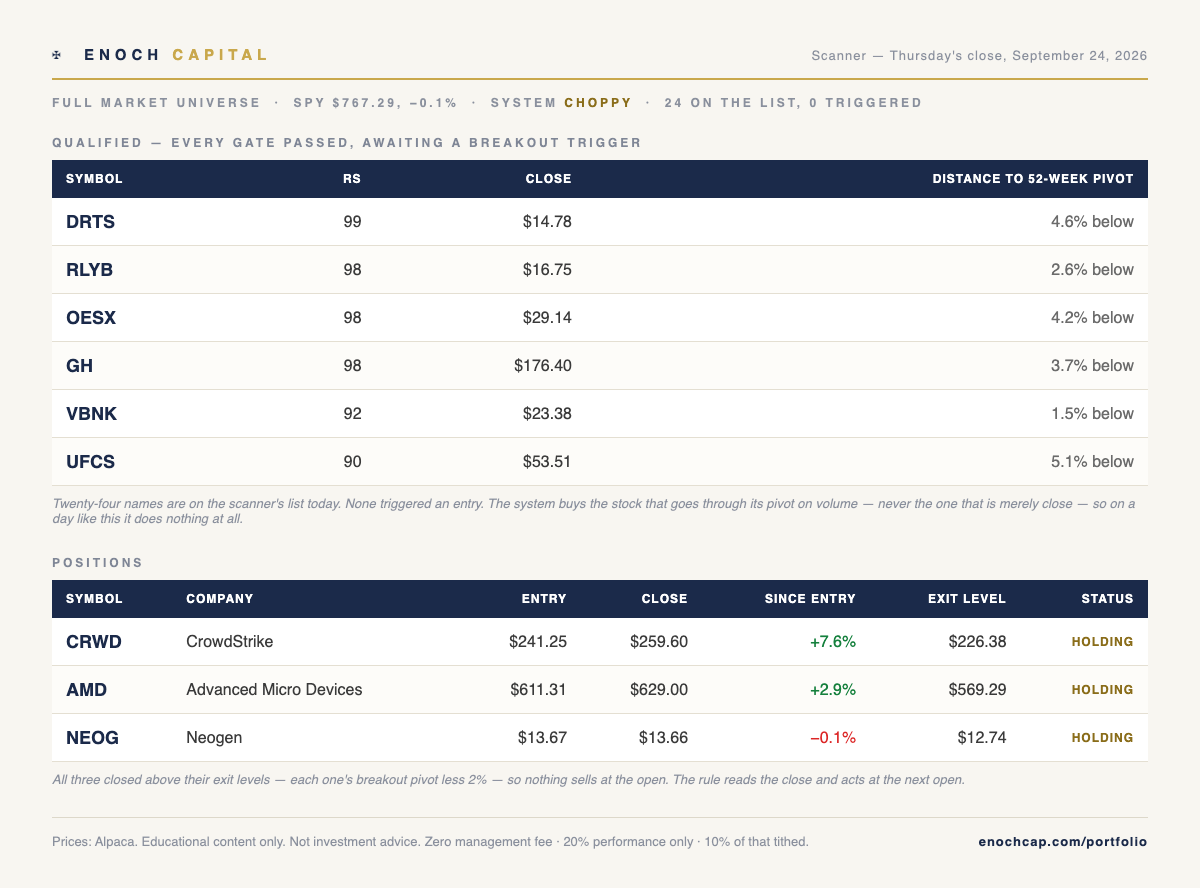
Thursday's close: SPY $767.29, −0.1% · Nasdaq 100 flat · Russell 2000 −0.1% · system CHOPPY, no new entries
Ecclesiastes also has the market's whole vocabulary in one verse: "A time to get, and a time to lose. A time to keep, and a time to cast away." The system does not guess which time it is. It waits for price to say so, and until then it keeps what it holds and buys nothing. Aquinas would recognize the method: memory of many cases, set in order toward an end, with no attempt to predict.
Thursday was quiet. The S&P 500 fund closed at $767.29, down 0.1%, the Nasdaq 100 fund was flat, and small caps slipped 0.1%. The regime stays choppy. The scanner's list holds twenty-four names at or near their 52-week pivots. None triggered an entry, so the system bought nothing.
The three long positions held. CrowdStrike (CRWD) closed at $259.60, down 1.1% on the day and 7.6% above its entry of $241.25. AMD rose 2.3% to $629.00, 2.9% above its entry of $611.31. Neogen (NEOG) closed at $13.66, a penny under its entry of $13.67. Each closed above its exit level, its breakout pivot less 2%, at $226.38, $569.29 and $12.74, so nothing sells at the open.
Enoch Capital · Chart · Research & Due Diligence
→ Zero management fee. 20% performance only. 10% of that tithed.
The week ahead, per the USCCB General Roman Calendar for the United States:
St. Thomas Aquinas, pray for us — that we would learn slowly what only time can teach.
In Christ,
Jonathan Simmons
Enoch Capital LLC
Catholic Daily goes out Monday through Saturday.
LinkedIn · X @jonenochcap · enochcap.com
Enoch Capital LLC · 2121 S. Broadway, #511, Denver CO 80210
Catholic Daily is an educational publication. It is not investment advice. References to markets, specific securities, or economic conditions are illustrative only and do not constitute recommendations to buy or sell any security. Past performance does not guarantee future results.
Enoch Capital LLC operates under the Publisher's Exemption from the Investment Advisers Act of 1940 (Lowe v. SEC, 472 U.S. 181, 1985). Nothing on this site constitutes the rendering of personalized investment advice. Enoch Capital LLC is not a registered investment adviser.