Good morning.
His own archbishop told the Pope he had caught him faking the wounds with acid. Padre Pio said nothing in his own defense — and obeyed the silence they imposed on him for it.
Memorial of Saint Pius of Pietrelcina, Priest
The first reading is Agur's prayer, and it asks for two things. The first: "Add not any thing to his words, lest thou be reproved and found a liar." The second: "Give me neither beggary, nor riches: give me only the necessaries of life: lest perhaps being filled, I should be tempted to deny, and say: Who is the Lord? or being compelled by poverty, I should steal, and forswear the name of my God." (Proverbs 30:6, 8-9)
The psalm response runs underneath both: Your word, O Lord, is a lamp for my feet.
bible.usccb.org/bible/readings/092326.cfm →
Wednesday belongs to Him
Read the Gospel slowly and notice what it actually says. The power to cast out devils and to cure diseases is Christ's own. He does not teach the Twelve a technique. He gives them what belongs to Him, and then sends them out carrying nothing — no staff, no bread, no money, not even a change of clothes.
That is the whole pattern of the saint we remember today, and it is worth saying plainly before anything else about him: the wounds Padre Pio carried in his hands for fifty years were not his achievement. They were not a prize for holiness. They were Christ's wounds, and a man was permitted to carry them for a while. Everything remarkable about him is on loan, which is exactly how he treated it.
A false accusation, and two years of silence
Francesco Forgione was born May 25, 1887, in Pietrelcina, a hill town in southern Italy. His father, Grazio, was a farmer. When the boy needed more schooling than the family could pay for, his father crossed the Atlantic and worked in America to fund the tutoring. He entered the Capuchin novitiate at Morcone on January 6, 1903, took the name Pio, and was ordained on August 10, 1910.
On September 20, 1918, while praying before a crucifix in the friary church at San Giovanni Rotondo, he received the visible stigmata. He bore the wounds for roughly fifty years. They closed without leaving a scar in the last days of his life.
What happened next is not a vague story about crowds and suspicion. It has a name attached to it. Pasquale Gagliardi, the archbishop of the diocese Padre Pio belonged to, told Pope Pius XI directly that he had found a vial of acid and a bottle of cologne, and swore that Padre Pio used them to inflict the wounds on himself and perfume the result. It was a specific, deliberate charge of fraud, made by his own bishop.
The Church did not simply take the accusation on faith. Two years earlier, in June 1921, Bishop Raffaello Carlo Rossi had already spent eight days at San Giovanni Rotondo on the Holy Office's own authority, examined the wounds directly, and questioned Padre Pio under oath through 142 questions. Rossi's report ruled out fraud and called him "a good and exemplary religious." The evidence in Rome's own hands did not support the charge against him. In May 1923 the Holy Office issued a decree discouraging devotion to him anyway. Eight years later, in 1931, it went much further: no confessional, no public Mass, confined to the friary, his letters restricted — the real silencing, and it lasted about two years.
He obeyed. He did not campaign, did not publish a rebuttal, did not permit a faction to form around his grievance. What is handed down of his response is four words and a conclusion: God's will be done. The will of the superiors is the will of God. An indult signed July 14, 1933 lifted the restriction; Pius XI is reported to have said, "I have not been badly disposed toward Padre Pio, but I have been badly informed." Even then, lay confessions were not yet restored — men in March 1934, women that May. From the false charge to full restoration was more than a decade. The severe silencing itself — the two years he is remembered for — was shorter, and no less obeyed for it.
He went back to the confessional and stayed there. In the early years he heard confessions fifteen hours a day and more. In 1956 he opened the Casa Sollievo della Sofferenza — the Home for the Relief of Suffering — a real hospital, still running, built because the sick who came to him needed medicine as well as absolution. He died on September 23, 1968, and was canonized by John Paul II on June 16, 2002.
The life as it is told
Restored to the confessional in 1933, he never really left it again. By the 1950s and '60s he was hearing confessions five to eight hours a day, and over his lifetime an estimated five million — most of them three minutes long, because he could see straight to what mattered. By 1967 the friars were confessing roughly 15,000 women and 10,000 men a year through him alone, seventy people a day. A first confession with him could mean a wait of ten days to several weeks; by 1950 the friary had to issue tickets just to manage the line.
To the people who could not make that journey, he gave a different instruction: send your guardian angel. An Englishman named Cecil Humphrey-Smith, injured in a car accident in Italy, had a friend wire Padre Pio a prayer request; word of Padre Pio's prayers came back before the friend's telegram could have physically arrived. When they finally met, Padre Pio asked him, "Do you think the Angels go as slowly as the planes?" Of his own guardian angel he wrote to his spiritual director of a lifelong companion who had woken him for prayer since childhood, and who translated the foreign-language letters that arrived from correspondents he had never met: "My companion translates everything." He had seen and known that companion since he was a small child, and he never stopped seeing him — not a doctrine he taught in the abstract, but a presence as plain to him as his own brother.
The stigmata, the confessional, and the angel were not separate wonders to him. One government of grace, seen from several angles, and the rest of his life carries the same pattern throughout.
As a young seminarian in 1905, he told his spiritual director that he had found himself present, in spirit, at a house in Udine where a man lay dying and his wife was giving birth — Our Lady, he said, had entrusted the newborn girl to him. Elsewhere in his life the same gift shows itself even more vividly. A young mother, far from him and caught by her labor before help could reach her, found herself through it in a courtyard in a storm, guided by a presence at her side she could not place — and Padre Pio, back at the friary, was found afterward as he so often was after these hours: gone somewhere his body would not follow, his habit inexplicably wet, as though he had truly stood in that rain. He never spoke of it himself. Years later the child that mother had borne, by then a grown woman, made the journey to San Giovanni Rotondo to see him for the first time in her life. He knew her before she said a word. "I have been waiting for you," he told her — the same line, the same gift, given twice.
A woman named Cleonice Morcaldi came to see him in 1920 meaning to stay a single day. When the hour came to leave, her legs would not carry her to the door — she tried, and could not, and understood it in time as Our Lord and Our Lady asking her to remain and give her life to his service instead of returning to the one she had planned. She stayed at his side until his death in 1968, and kept serving the poor in his name for nearly twenty years after, until her own death in 1987. Sixty-seven years, from a visit that was never meant to outlast a single afternoon.
The hospital he built, Casa Sollievo della Sofferenza, was funded in part by a spiritual son named Emanuele Brunatto, who gave the land itself and later a large sum from his own business — and, by another account carried alongside it, by a poor man who won a lottery and brought Padre Pio the whole of his winnings, asking nothing for himself but to see the hospital rise. And more than once, those close to him found that his hand had left something behind it: the shape of a cross, pressed or scorched into a glove, a rosary, the wood of a door he had blessed in passing — as though the wounds he carried in his own flesh could, every so often, mark what he touched the same way they had marked him.
A correction worth making on his feast
The first reading today warns against a specific sin, and this saint is its most abused modern victim: "Add not any thing to his words, lest thou be reproved and found a liar."
A great deal circulates online under Padre Pio's name that he did not say. The best-known is a letter prophesying "Three Days of Darkness." It is a forgery. It traces to a German pseudo-mystical group later condemned by the Church, and it has been denounced as false by his own Capuchin order and by the Archdiocese of Bamberg since 1950. Padre Pio himself, asked about it, denied it emphatically and called it a forgery. The same applies to various prophecies of a coming monarch attached to his name. There is a simple test that disposes of most of them: his superiors forbade him to write personal letters from 1924 onward, and he kept that obedience, so a letter dated after 1924 is very difficult to credit as his.
None of this diminishes him. It is the opposite. The real Padre Pio bore the wounds of Christ for fifty years, carried a false accusation from his own archbishop, and obeyed years of restriction built on it without complaint. That is a harder and better story than any prediction, and it has the advantage of being true. When someone repeats a prophecy under a saint's name, the honest question is the one the reading asks: can you show that he said it, or are you only repeating that he did?
That question is not confined to piety. It is the same test that governs a prospectus, an earnings call, and a claim about what a system can do. Repeating is cheap. Proving is the work.
Neither beggary nor riches
Agur asks for the exact middle: not poverty, not wealth, but the necessaries of life — and he gives the reason in economic terms. Wealth tempts a man to say Who is the Lord? Destitution drives him to steal and to forswear God's name. Both ends corrupt; the danger is at both ends, not only one.
This is not a counsel against prosperity, and the Church has never taught that it is. It is a warning that a number large enough stops being a means and becomes an answer to a question it cannot answer. Padre Pio's own test of sufficiency was practical: he owned nothing, and he built a hospital. The money was real and it went into walls, beds, and medicine for people who needed them. Enough, in the tradition, is the amount that lets you do the work you were given and does not begin to do your thinking for you.
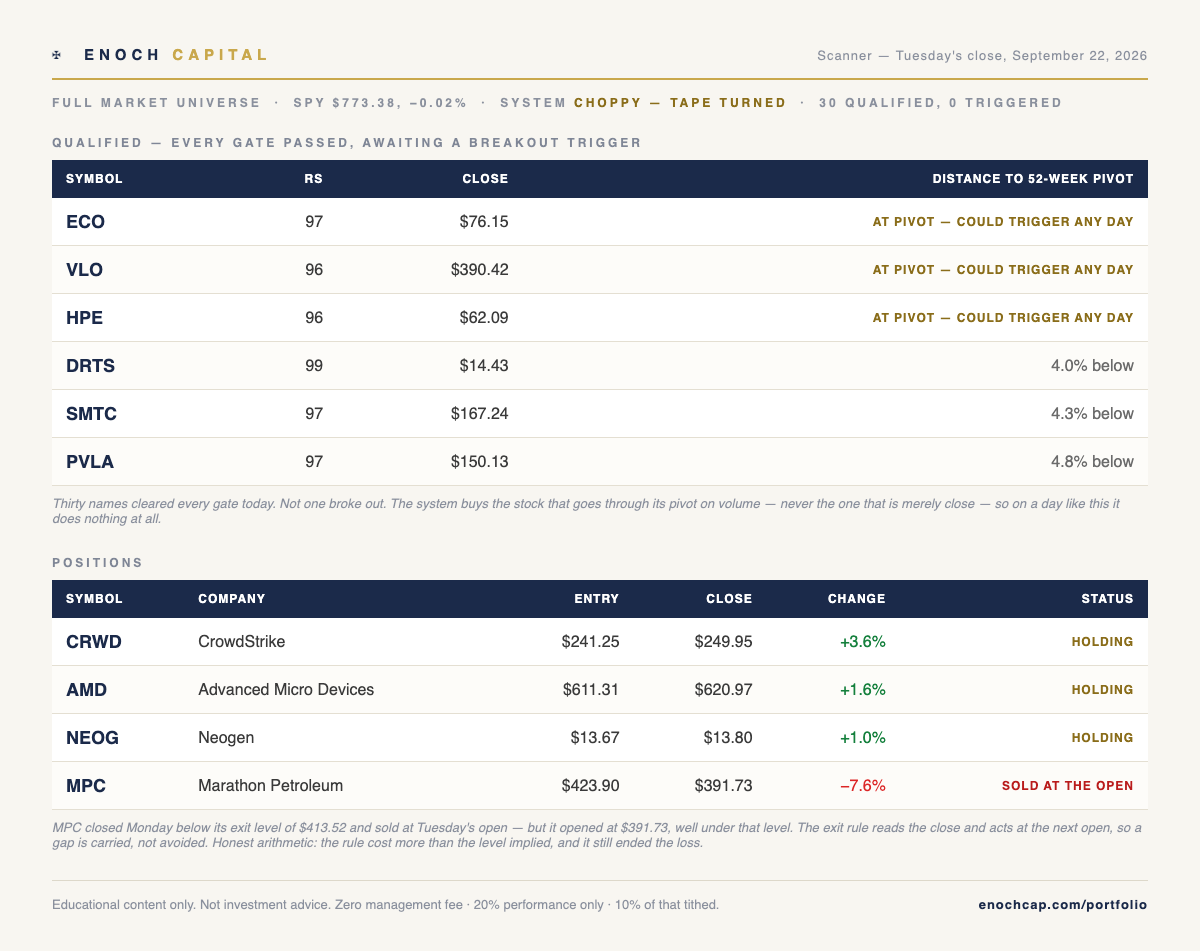
Tuesday's close: SPY $773.38, essentially flat · regime CHOPPY, down from bullish · day +0.1%
The tape changed character. Monday closed bullish; Tuesday the regime gate read choppy, which tightens the system's own rules — fewer positions permitted, and a higher relative-strength bar before anything new is allowed in. Nothing about the day was dramatic. The S&P 500 fund finished twelve cents lower than it started.
Underneath that flat surface, the scan found thirty names that qualified. Not one of them triggered. Three are sitting exactly at their 52-week pivot — Okeanis Eco Tankers (ECO) at $76.15, Valero (VLO) at $390.42, and Hewlett Packard Enterprise (HPE) at $62.09 — any of which could break out on any given morning. Three more are within five percent of theirs. The system does not buy a stock that is close. It buys the one that goes through, on volume, and until then it does nothing.
The positions already open did their work quietly: CrowdStrike (CRWD) +3.6% from entry, AMD +1.6%, Neogen (NEOG) +1.0%. Marathon Petroleum (MPC) was sold at Tuesday's open, as Monday's close below its exit level required — and that sale is worth reporting honestly, because it did not go well. The exit level was $413.52. The stock opened at $391.73, and that is where it sold: a 7.6% loss rather than the 2.5% the level implied. The rule reads the closing price and acts at the next morning's open, so when a stock gaps down overnight the gap is carried, not avoided. The rule still did its work — it ended the loss instead of letting it run — but it cost more than the number on paper suggested, and a letter that reported only the number on paper would be worth less than one that says so.
That is a full trading day in which the right answer was to sit still — thirty qualified names, zero bought, and a portfolio that moved a tenth of a percent. Livermore said the money is in the sitting. Today is what that actually looks like, and it is worth noticing on the feast of a man who was falsely accused, silenced for two years, and never argued his own case.
Enoch Capital · Chart · Research & Due Diligence
→ Zero management fee. 20% performance only. 10% of that tithed.
The week ahead, per the USCCB General Roman Calendar for the United States:
St. Padre Pio, pray for us — that we would carry what is lent to us, and add nothing to it.
In Christ,
Jonathan Simmons
Enoch Capital LLC
Catholic Daily goes out Monday through Saturday.
LinkedIn · X @jonenochcap · enochcap.com
Enoch Capital LLC · 2121 S. Broadway, #511, Denver CO 80210
Catholic Daily is an educational publication. It is not investment advice. References to markets, specific securities, or economic conditions are illustrative only and do not constitute recommendations to buy or sell any security. Past performance does not guarantee future results.
Enoch Capital LLC operates under the Publisher's Exemption from the Investment Advisers Act of 1940 (Lowe v. SEC, 472 U.S. 181, 1985). Nothing on this site constitutes the rendering of personalized investment advice. Enoch Capital LLC is not a registered investment adviser.