Good morning.
Wednesday belongs to Our Lord. Today's Gospel is the parable of the pounds, which He told on the road to Jerusalem, near the end. The first reading is from the Apocalypse, the throne in heaven and the four living creatures.
Wednesday of the Thirty-third Week in Ordinary Time
Optional memorials: the Dedication of the Basilicas of Saints Peter and Paul, Apostles; St. Rose Philippine Duchesne, Virgin
First reading (Apocalypse 4:1-11): John is called up into heaven and sees a throne, and the one who sits on it, with twenty-four elders around it and four living creatures before it, who say without rest the words of the Responsorial refrain: "Holy, holy, holy Lord, mighty God." The elders cast their crowns before the throne: "Thou art worthy, O Lord our God, to receive glory, and honour, and power: because thou hast created all things;"
The Gospel (Luke 19:11-28): Jesus tells a parable because He is near Jerusalem and the crowd thinks the kingdom of God is about to appear at once. A nobleman goes to a far country to receive a kingdom. "And calling his ten servants, he gave them ten pounds, and said to them: Trade till I come." His citizens hate him and send word after him that they will not have him to reign over them. He returns a king and calls the servants to account. The first has made ten pounds more, and the second five. To the first he says: "Well done, thou good servant, because thou hast been faithful in a little", and gives him authority over ten cities, and the second over five. The third comes with the pound he kept in a napkin, and says he was afraid, because the master is a hard man. The master takes the pound from him and gives it to the one who has ten: "to every one that hath shall be given, and he shall abound". The passage ends with Jesus going on ahead of the crowd, up to Jerusalem.
The full readings are on USCCB.org.
bible.usccb.org/bible/readings/111826.cfm →
The Catena Aurea reads the parable first as the stewardship of the Gospel, and of what Christ gave to those who believe in Him; the pound is what each servant was entrusted with, and the nobleman is Christ going to His Father to receive His kingdom and to return.
Chrysostom draws a line that applies to every kind of wealth: "For in earthly matters participation lessens, in spiritual it increases wealth." The more people share a thing of this world, the less of it each has. A truth shared goes the other way. And on the servant's excuse he adds that "with regard to the words of God, we are not only bound diligently to keep, but we are commanded to increase."
Theophylact notices the napkin: the face of the dead is covered with one, and the idle servant is said to have wrapped up his pound there because "leaving it dead and unprofitable he neither touched nor increased it."
A reading of our own, not a Father's. The third servant lost nothing; he handed back every coin. What the master answers is that he gave nothing to the work. The first two are praised for being faithful in a little, and the word the passage keeps coming back to is trade.
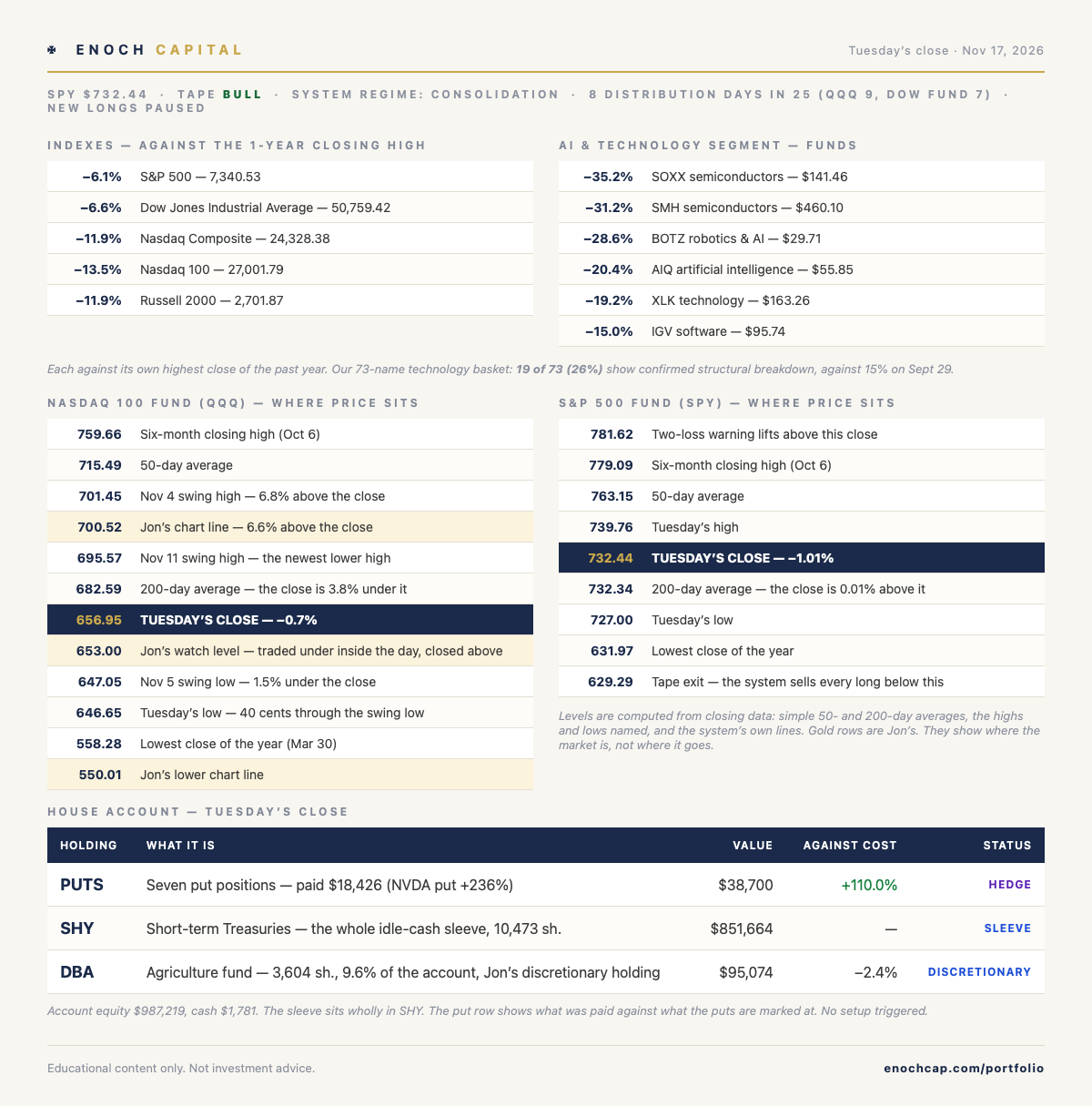
SPY $732.44, −1.01% · Nasdaq 100 fund (QQQ) $656.95, −0.73% · Dow fund (DIA) $507.31, −1.62% · VIX 25.46 · tape BULL, system regime: consolidation · new longs still paused by the two-loss warning
The market closed lower again, and the weight of it is in one place: the AI and technology segment. Here is the whole picture, from the three big indexes to the segment inside them.
The indexes. Each against its own highest close of the past year, at Tuesday's close:
→ S&P 500: 7,340.53, down 6.1% from 7,818.93 (October 6)
→ Dow Jones Industrial Average: 50,759.42, down 6.6% from 54,349.12 (August 5)
→ Nasdaq Composite: 24,328.38, down 11.9% from 27,599.79 (October 6)
→ Nasdaq 100: 27,001.79, down 13.5% from 31,224.47 (October 6)
→ Russell 2000: 2,701.87, down 11.9% from 3,068.42 (August 14)
By the usual measure, a decline of 10% or more from the high, the Nasdaq and the small-cap index are in a correction. The S&P 500 and the Dow are three to four points short of it, and both closed within a tenth of a percent of their own 200-day averages; the Nasdaq Composite is 3.3% under its own. We do not call the market as a whole in a correction on the S&P 500 alone. That would need all three indexes to agree, and Tuesday they did not. What the numbers show is a decline led by technology and small companies, with the broad large-cap indexes close behind it.
The Nasdaq 100 fund closed at $656.95, down 0.7% from $661.75, after opening at $663.05 and trading between $646.65 and $663.36. It is the lowest close since November 6, when it closed at $656.10. The S&P 500 fund closed at $732.44, down 1.0% from $739.95, in a range of $727.00 to $739.76. The Dow fund fell 1.6% to $507.31. The VIX rose from 22.91 to 25.46. We found no single headline in our news feed that explains the fall.
The AI and technology segment. Nvidia is one name in it. Each fund against its own highest close of the past year, at Tuesday's close:
→ Semiconductors: SMH $460.10, down 31.2%; SOXX $141.46, down 35.2%
→ Artificial intelligence: AIQ $55.85, down 20.4%; BOTZ (robotics and AI) $29.71, down 28.6%
→ Technology: XLK $163.26, down 19.2%; software, IGV $95.74, down 15.0%
→ Nasdaq 100: QQQ $656.95, down 13.5%
Since November 3 the semiconductor funds are down 9% to 11%, XLK 7.5% and AIQ 6.2%. The segment funds are 4% to 18% under their 200-day averages, except software, which is 1.6% above. The segment is down further from its high than any of the three big indexes, and the S&P 500 and the Dow have not followed it that far.
We also keep a basket of 73 technology names, the holdings of the XLK fund as of September 17, and count how many show confirmed structural breakdown: weakening rallies, two lower pivot highs, a price 15% or more under the six-month high, and a break of support on volume. Tonight 19 of the 73 qualify, 26%. On September 29 it was 11 of 72, 15%, and on September 19 it was also 11 of 72. The average name is 31% under its own six-month high, and the median name is up 22% over twelve months, down from 26% on September 29. So 54 of the 73 are not breaking down by that test: the segment is thinning from the edges, and the leaders have not all gone. The four weakest by twelve-month return are FICO, Intuit, Oracle and ServiceNow. This is a count we run ourselves, on one definition, and it changes with the basket.
Inside the segment the names do not move together. From each name's high over the past year: Nvidia is 35.0% under, Micron 41.3%, Broadcom 29.1%, Oracle 53.7%, CoreWeave 63.8%, AMD 22.5% (and 18% over its 200-day), Microsoft 8.9% and Amazon 9.2%. Since November 3, Nvidia is down 24.8% and Micron 16.7%, while Broadcom is up 2.9%, AMD 4.0% and Amazon 2.9%.
Nvidia closed at $155.46, down 0.4%, and reported after the close. We have not read the release as we write this; in the extended session the shares were trading about 3.6% higher at the last print we saw, and extended-hours prices are thin. Press headlines Tuesday, from the Benzinga feed and not verified against filings: an export-compliance warning from Nvidia to chip buyers, and a new national-security and export-control oversight committee. The account holds no NVDA shares; it holds one NVDA put, and puts on five other names and funds in this segment: XLK, SOXX, Oracle, Palantir and CoreWeave.
Distribution days. By our own count the Nasdaq 100 fund added one on Tuesday and now has 9 in the last 25 sessions; the S&P 500 fund did not add one and stays at 8; the Dow fund has 7. The oldest days leave the window this week: October 14 with Wednesday's session for the S&P 500 and the Nasdaq 100 funds, and October 16 with Friday's for all three.
Tuesday's low. The Nasdaq 100 fund traded as low as $646.65 during the day, 40 cents under the November 5 swing low of $647.05, and under Jon's $653. It closed at $656.95, above both. We note it as it happened: the line was touched inside the day and held at the close. The swing highs are unchanged, five in a row, each lower than the one before: $762.86, $727.95, $726.14, $701.45, $695.57.
This week. Per the calendar, Target, TJX and Lowe's report Wednesday before the open and Palo Alto Networks Wednesday after the close; Walmart reports Thursday before the open, and Intuit and Ross Stores Thursday after the close. Calendar dates can move.
Where price sits. Levels are computed from closing data. We name them so the reader can see where the market is, not to say where it will go.
Nasdaq 100 fund (QQQ), closed at $656.95:
→ $759.66, the six-month closing high (October 6), 15.6% above the close; the 50-day average is $715.49
→ $701.45, the November 4 swing high, 6.8% above the close; $695.57, the November 11 swing high, the latest lower high, 5.9% above
→ $700.52, Jon's upper chart line, 6.6% above the close
→ $682.59, the 200-day average, 3.9% above the close
→ $653, the level Jon has been watching, 0.6% under the close; traded under during Tuesday, not closed under
→ $647.05, the November 5 swing low, 1.5% under the close; Tuesday's low of $646.65 went 40 cents through it
→ $558.28, the lowest close of the past year (March 30), 15.0% under the close; Jon's lower chart line, $550.01, is 16.3% under
S&P 500 fund (SPY), closed at $732.44:
→ $781.62, the close above which the two-loss warning lifts and the system can take new longs, 6.7% above the close
→ $779.09, the six-month closing high (October 6); the 50-day average is $763.15
→ $732.34, the 200-day average; the close is 0.01% above it
→ $631.97, the lowest close of the past year, and $629.29, the line the system's tape exit uses; the tape turns, and the system sells every long, only on a SPY close below it. A fall of 14.1% from Tuesday's close would reach it.
Where Jon thinks it goes. Jon's view is in the lines: his read is that the market will still correct, and that a lower trend in the Nasdaq 100 fund may already have started. Tuesday fits the shape he drew: the fund came down to his $653 inside the day and closed 0.6% above it. What would not fit it is a trade back above $701.45 and a pullback that holds above $647.05. What would extend it is a close below $647.05. These are his marks, drawn on a chart, and we hold them as we hold any prophecy: it is not true until it happens.
The account. The house account closed Tuesday at $987,219, with $1,781 in cash. The idle-cash sleeve is wholly in SHY, the short-term Treasury fund: 10,473 shares, $851,664. Outside the sleeve it holds one stock position, the Invesco DB Agriculture Fund (DBA): 3,604 shares, $95,074, 9.6% of the account, 2.4% below its cost. The seven put positions, ten contracts in all, cost $18,426 and are marked at $38,700, up 110%.
Compared with Monday's close ($985,011), the account is up $2,208: the puts gained $1,302, SHY $942, and DBA lost $36. The NVDA put, a $210 strike expiring June 17, 2027, is marked at $5,825 against $1,735 paid. The others: the QQQ put $6,130 against $2,551 paid, the four XLK puts $10,000 against $4,620, SOXX $9,200 against $5,240, CoreWeave $2,995 against $1,225, Oracle $1,930 against $1,250, and Palantir $2,620 against $1,805.
Put watch. The seven puts were bought on September 29 to stand in for stop orders: a stop can gap through its price, and a put cannot lose more than was paid for it. The rules we follow, set out in plain terms: take a put's profit when it is up 200%, cash in if the Nasdaq-100 fund (QQQ) is below $653 on a panic day, close if QQQ climbs back above $700.52, look again at 60 days left, and keep any one put under 1% of the account. On Tuesday's marks the puts were up 110% as a group; the NVDA put, up 236% on that mark, is past the 200% line and is being kept for now, by choice. None of these thresholds has been validated against real options history; our replay on QQQ data is a model, not a record. The scanner now also looks for new puts: the mirror of the stocks near a breakout are the stocks near a breakdown. Wednesday's scan found none through every gate and seven close to their support: Netflix, Axon, Caterpillar, Alphabet, Qualcomm, Cisco and Corning. A watch is not a recommendation.
The system takes no new long until SPY closes above $781.62. The scanner's list holds twenty-six names at or near their 52-week pivots, and none triggered.
Enoch Capital · Chart · Research & Due Diligence
→ Zero management fee. 20% performance only. 10% of that tithed.
Wednesday, November 18, is an ordinary trading day: stocks and exchange-traded funds trade 9:30 AM to 4:00 PM ET. Target, TJX and Lowe's report before the open, and Palo Alto Networks after the close. The Federal Open Market Committee meets December 8-9.
The week ahead, per the USCCB daily readings calendar for the United States:
Holy Mary, Mother of God, pray for us.
In Christ,
Jonathan Simmons
Enoch Capital LLC
Catholic Daily goes out Monday through Saturday.
LinkedIn · X @jonenochcap · enochcap.com
Enoch Capital LLC · 2121 S. Broadway, #511, Denver CO 80210
Catholic Daily is an educational publication. It is not investment advice. References to markets, specific securities, or economic conditions are illustrative only and do not constitute recommendations to buy or sell any security. Past performance does not guarantee future results.
Enoch Capital LLC operates under the Publisher's Exemption from the Investment Advisers Act of 1940 (Lowe v. SEC, 472 U.S. 181, 1985). Nothing on this site constitutes the rendering of personalized investment advice. Enoch Capital LLC is not a registered investment adviser.