Good morning.
Joseph took the Boy up to Jerusalem every year at Passover, and the Gospel records the one year they went home without Him.
Feast of the Dedication of the Lateran Basilica in Rome
Gospel (John 2:13-17): "And the pasch of the Jews was at hand, and Jesus went up to Jerusalem. And he found in the temple them that sold oxen and sheep and doves, and the changers of money sitting. And when he had made, as it were, a scourge of little cords, he drove them all out of the temple, the sheep also and the oxen, and the money of the changers he poured out, and the tables he overthrew. And to them that sold doves he said: Take these things hence, and make not the house of my Father a house of traffic. And his disciples remembered, that it was written: The zeal of thy house hath eaten me up."
The Latin of the rule is nolite facere domum patris mei, domum negotiationis.
Then the question and the answer (John 2:18-22): "The Jews, therefore, answered, and said to him: What sign dost thou shew unto us, seeing thou dost these things? Jesus answered, and said to them: Destroy this temple, and in three days I will raise it up. The Jews then said: Six and forty years was this temple in building; and wilt thou raise it up in three days? But he spoke of the temple of his body. When therefore he was risen again from the dead, his disciples remembered, that he had said this, and they believed the scripture, and the word that Jesus had said."
The Church puts this Gospel on the anniversary of a building, and the Gospel is about a man who would not let a building be used for the wrong thing. In the Catena Aurea, Augustine asks the question a trader would ask: "And what did they sell? Things that were necessary for the sacrifice of that time." The oxen, the sheep and the doves were what the Law called for. Bede explains how they came to be in the court: "Those however, who came from a distance, being unable to bring with them the animals required for sacrifice, brought the money instead. For their convenience the Scribes and Pharisees ordered animals to be sold in the temple…" The goods were lawful and the service was a convenience. What the Lord drove out was the house turned into a market.
Chrysostom notices a word: "For the same reason, to show His agreement with God, He said not, the Holy house, but, My Father's house." And Augustine, on the zeal the disciples remembered: "He then is eaten up with zeal for God's house, who desires to correct all that he sees wrong there; and, if he cannot correct, endures and mourns."
The first reading is Ezekiel's river. Water comes out from under the threshold of the house and runs east, and "every living creature that creepeth whithersoever the torrent shall come, shall live." On its banks "shall grow all trees that bear fruit: their leaf shall not fall off, and their fruit shall not fail: every month shall they bring forth firstfruits, because the waters thereof shall issue out of the sanctuary: and the fruits thereof shall be for food, and the leaves thereof for medicine." (Ezekiel 47:9, 12)
The second reading is Paul to the Corinthians: "For we are God's coadjutors: you are God's husbandry; you are God's building. According to the grace of God that is given to me, as a wise architect, I have laid the foundation; and another buildeth thereon. But let every man take heed how he buildeth thereupon. For other foundation no man can lay, but that which is laid; which is Christ Jesus." Then: "Know you not, that you are the temple of God, and that the Spirit of God dwelleth in you?" (1 Corinthians 3:9-11, 16) The Latin of that last line is Nescitis quia templum Dei estis, et Spiritus Dei habitat in vobis?
The full readings are on USCCB.org.
bible.usccb.org/bible/readings/110926.cfm →
Luke tells it in a few lines. "And his parents went every year to Jerusalem, at the solemn day of the pasch. And when he was twelve years old, they going up into Jerusalem, according to the custom of the feast, and having fulfilled the days, when they returned, the child Jesus remained in Jerusalem; and his parents knew it not." They went a day's journey, turned back, and "after three days, they found him in the temple, sitting in the midst of the doctors, hearing them, and asking them questions." (Luke 2:41-46)
Mary speaks first: "Son, why hast thou done so to us? behold thy father and I have sought thee sorrowing." And He answers: "How is it that you sought me? did you not know, that I must be about my father's business?" The Latin is nesciebatis quia in his quae Patris mei sunt, oportet me esse? (Luke 2:48-49)
Two fathers are in that exchange, and the Church has always read it carefully. Origen, in the Catena Aurea: "the Holy Spirit honored Joseph by the name of father, because he brought up the Child Jesus." Bede is careful about what the Lord's answer does and does not say: "He blames them not that they seek Him as their son, but compels them to raise the eyes of their mind to what was rather due to Him whose eternal Son He was." Joseph does not answer. The Gospel records no word of his, here or anywhere. Luke says only that Jesus "went down with them, and came to Nazareth, and was subject to them", and the Boy who has just spoken of His Father's house goes home to Joseph's.
Origen also gives the instruction that is in the story. They did not find Him among kinsfolk or acquaintances: "Where then do they find Him? In the temple! If at any time you seek the Son of God, seek Him first in the temple."
The Church has made Joseph her patron. On December 8, 1870, the Sacred Congregation of Rites published the decree Quemadmodum Deus, which says that Pius IX "has solemnly declared him Patron of the Catholic Church." Monday belongs to him.
The feast commemorates the dedication of the cathedral of Rome. It was dedicated on November 9, 324, by Pope Sylvester I, and the Church has kept the anniversary as a feast since the twelfth century. The basilica's own site gives the inscription on both sides of its central entrance: omnium Urbis et Orbis ecclesiarum Mater et Caput, "mother and head of all the churches of the city and of the world." It says the popes lived at Saint John Lateran until their exile to Avignon.
The Catechism (583) puts Joseph and the Temple in one paragraph: "It was in the Temple that Joseph and Mary presented him forty days after his birth. At the age of twelve he decided to remain in the Temple to remind his parents that he must be about his Father's business. He went there each year during his hidden life at least for Passover."
And 584 says what the Lord did in it: "Jesus went up to the Temple as the privileged place of encounter with God. For him, the Temple was the dwelling of his Father, a house of prayer, and he was angered that its outer court had become a place of commerce. He drove merchants out of it because of jealous love for his Father." The reason given is love of the Father, and the paragraph says nothing against the merchants' work.
Paragraph 756 turns the same image toward the reader: "Often, too, the Church is called the building of God... the house of God in which his family dwells... As living stones we here on earth are built into it." Paul says it more briefly in today's second reading: you are God's building.
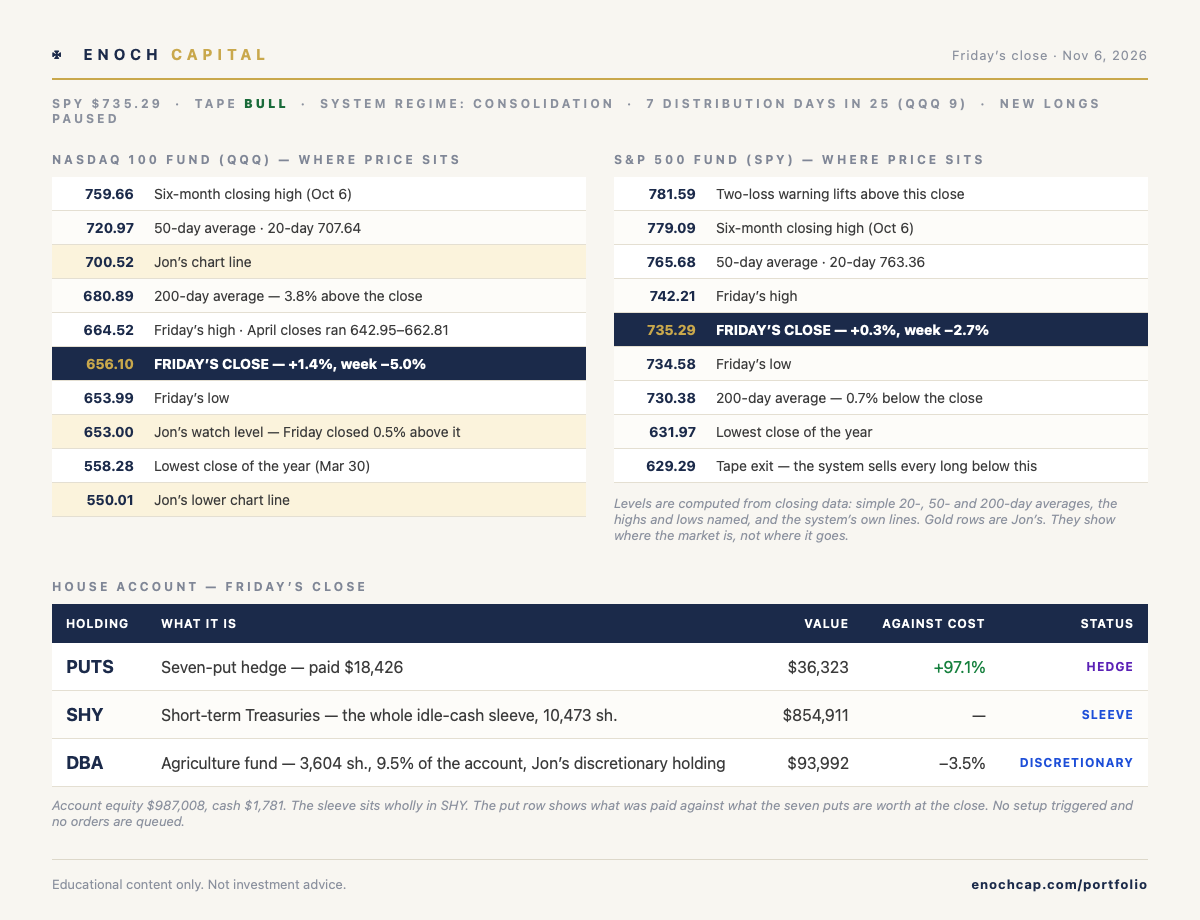
Friday's close: SPY $735.29, +0.3% · Nasdaq 100 fund (QQQ) $656.10, +1.4% · week: SPY −2.7%, QQQ −5.0% · tape BULL, system regime: consolidation · new longs still paused by the two-loss warning
Stocks are closed on Saturday and Sunday, so the last close is Friday's. The Nasdaq 100 fund closed at $656.10, up 1.4% from $647.05, after a range of $653.99 to $664.52. It did not trade under Jon's $653 at any point in the regular session, and it closed $3.10 above it. The S&P 500 fund closed at $735.29, up 0.3% from $733.00, in a range of $734.58 to $742.21. Friday's Employment Situation report from the Bureau of Labor Statistics showed payrolls up 165,000 in October and unemployment at 4.1%; those figures are the BLS's, and we did not find a second source.
The week. The S&P 500 fund fell 2.7% from its October 30 close of $755.72, and the Nasdaq 100 fund 5.0%, from $690.49. The VIX rose from 19.42 to 25.64.
Friday was not a distribution day: both funds closed up. By our own count the S&P 500 fund has 7 distribution days in the last 25 sessions and the Nasdaq 100 fund has 9. The oldest for the S&P 500 fund, October 8, ages out after the November 12 session if no new ones are added; for the Nasdaq 100 fund, October 12 follows it a session later.
Where price sits. Levels are computed from closing data. We name them so the reader can see where the market is, not to say where it will go.
Nasdaq 100 fund (QQQ), closed at $656.10:
→ $759.66, the six-month closing high (October 6); the 50-day average is $720.97 and the 20-day $707.64
→ $700.52, Jon's upper chart line, 6.8% above Friday's close
→ $680.89, the 200-day average, 3.8% above the close, which QQQ closed through on Thursday
→ $662.81, the top of the April 17-29 closes, which ran down to $642.95; Friday's high went $1.71 above it and the close finished under it
→ $653, the level Jon has been watching; Friday's low was $653.99
→ $558.28, the lowest close of the past year (March 30); Jon's lower chart line, $550.01, is 1.5% under it and 16.2% under Friday's close
S&P 500 fund (SPY), closed at $735.29:
→ $781.59, the close above which the two-loss warning lifts and the system can take new longs; Friday's close is 5.9% below it
→ $779.09, the six-month closing high (October 6); the 50-day average is $765.68 and the 20-day $763.36
→ $730.38, the 200-day average, 0.7% under the close
→ $631.97, the lowest close of the past year, and $629.29, the line the system's tape exit uses; the tape turns, and the system sells every long, only on a SPY close below it. Friday's close is 16.8% above it.
Where Jon thinks it goes. Jon's view is in the lines. He has been watching $653 as the level that has to break, and Friday's close held above it. His own read is that the market will still correct. The levels are where it can be checked: a bounce that stalls under the 200-day average ($680.89) and the April range would fit his read, and a close back above $700.52 would not. Below $653 the next marks are the April closes and then the March low. These are his marks, drawn on a chart, and we hold them as we hold every level here: where the market is, not a forecast.
The account. The house account closed Friday at $987,008, with $1,781 in cash. The idle-cash sleeve is wholly in SHY, the short-term Treasury fund: 10,473 shares, $854,911. Gold and long Treasuries are off-trend, and commodities (DBC) broke their channel Friday, so the sleeve holds no DBC. Outside the sleeve it holds one stock position, the Invesco DB Agriculture Fund (DBA): 3,604 shares. The seven puts cost $18,426 and closed at $36,323, up 97.1%.
The system takes no new long until SPY closes above $781.59. The scanner's list holds twenty-four names at or near their 52-week pivots, and none triggered. No orders were placed, and none are queued for Monday's open.
Enoch Capital · Chart · Research & Due Diligence
→ Zero management fee. 20% performance only. 10% of that tithed.
The Consumer Price Index for October comes out Tuesday, November 10, at 8:30 AM ET, and the Producer Price Index for October on Friday, November 13, at 8:30 AM ET (BLS release calendar). Wednesday, November 11, is Veterans Day, a federal holiday; the NYSE is open by our market calendar. The Federal Open Market Committee does not meet again until December 8-9.
Earnings. Dates and times are from Nasdaq's earnings calendar.
→ Monday, Nov 9: KKR, Constellation Energy and Barrick before the open; Occidental Petroleum, Skydance, Take-Two and Rocket Lab after the close
→ Tuesday, Nov 10: TransDigm and Sea before the open; Petrobras and CoreWeave after the close
→ Thursday, Nov 12: Brookfield and Nebius before the open; Cisco, Applied Materials and Cerebras after the close
The week ahead, per the USCCB daily readings calendar for the United States:
Saint Joseph, guardian of the house, pray for us.
In Christ,
Jonathan Simmons
Enoch Capital LLC
Catholic Daily goes out Monday through Saturday.
LinkedIn · X @jonenochcap · enochcap.com
Enoch Capital LLC · 2121 S. Broadway, #511, Denver CO 80210
Catholic Daily is an educational publication. It is not investment advice. References to markets, specific securities, or economic conditions are illustrative only and do not constitute recommendations to buy or sell any security. Past performance does not guarantee future results.
Enoch Capital LLC operates under the Publisher's Exemption from the Investment Advisers Act of 1940 (Lowe v. SEC, 472 U.S. 181, 1985). Nothing on this site constitutes the rendering of personalized investment advice. Enoch Capital LLC is not a registered investment adviser.