Good morning.
A rich man heard that his steward had been wasting his goods, and he called the man in for an account. The steward did not argue. He started working out where he would live.
Friday of the Thirty-first Week in Ordinary Time
Gospel, Luke 16:1-8: "And he said also to his disciples: There was a certain rich man who had a steward: and the same was accused unto him, that he had wasted his goods. And he called him, and said to him: How is it that I hear this of thee? give an account of thy stewardship: for now thou canst be steward no longer. And the steward said within himself: What shall I do, because my lord taketh away from me the stewardship? To dig I am not able; to beg I am ashamed. I know what I will do, that when I shall be removed from the stewardship, they may receive me into their houses. Therefore calling together every one of his lord's debtors, he said to the first: How much dost thou owe my lord? But he said: An hundred barrels of oil. And he said to him: Take thy bill and sit down quickly, and write fifty. Then he said to another: And how much dost thou owe? Who said: An hundred quarters of wheat. He said to him: Take thy bill, and write eighty. And the lord commended the unjust steward, forasmuch as he had done wisely: for the children of this world are wiser in their generation than the children of light."
The Latin of the last verse is quia filii hujus saeculi prudentiores filiis lucis in generatione sua sunt.
In the Catena Aurea, Pseudo-Chrysostom begins with the steward's mistake, which the rest of us share: "all the good things we possess in the course of our life we possess as lords over them." He answers it: "we are placed in this life not as lords in our own house, but as guests and strangers." And Ambrose says it shorter: "we are not ourselves the masters, but rather the stewards of the property of others."
The first reading is Paul, writing to the Philippians about people who live the other way: "whose end is destruction; whose God is their belly; and whose glory is in their shame; who mind earthly things. But our conversation is in heaven; from whence also we look for the Saviour, our Lord Jesus Christ" (Philippians 3:19-20). The chapter ends: "Therefore, my dearly beloved brethren, and most desired, my joy and my crown; so stand fast in the Lord, my dearly beloved" (Philippians 4:1).
The full readings are on USCCB.org.
bible.usccb.org/bible/readings/110626.cfm →
Summa Theologiae, Part II-II, question 55, article 1
The master praises the steward for something, and it is not the cheating. Augustine, in the Catena Aurea, is plain about that: the man is commended "because he provided himself against the future", and "we ought not however to take the whole for our imitation." What the Lord commends is that he looked ahead and acted.
Aquinas asks the question this raises: whether the prudence that looks ahead for the flesh is a sin. He begins with what prudence is. It "regards things which are directed to the end of life as a whole." It is foresight, and he notes that "prudence is so called from foreseeing [providendo]… which can extend to evil things also." The same skill that plans well can plan toward the wrong end.
"Hence prudence of the flesh signifies properly the prudence of a man who looks upon carnal goods as the last end of his life. Now it is evident that this is a sin, because it involves a disorder in man with respect to his last end."
He does not tell us to despise the body or what it needs. "The flesh is loved lawfully, if it be directed to the good of the soul as its end." The fault is in the last end. A man can plan carefully for food, a house and a livelihood, and Aquinas has no quarrel with it, so long as the plan is for something past them. And in his third reply he names the pair Luke 16:8 sets side by side: the world and the flesh are the two ways a man's foresight gets turned toward a lesser end, which is why Scripture speaks of "carnal" and "worldly" prudence, and why the Lord says the children of this world are wiser in their generation.
Paul's line in today's reading is the same thought from the other side: "who mind earthly things. But our conversation is in heaven." The steward's foresight went as far as a house that would take him in. The next verse in the Douay-Rheims turns it: "Make unto you friends of the mammon of iniquity; that when you shall fail, they may receive you into everlasting dwellings." The skill the steward used for himself, the Lord asks his disciples to use toward the dwellings that last.
Pseudo-Chrysostom puts the whole matter in a sentence a person can carry into a working day: "Therefore whoever you are, know yourself to be a dispenser of the things of others, and that the privileges granted you are for a brief and passing use."
Thursday's close: SPY $733.00, −4.4% · Nasdaq 100 −6.5% · pre-open Friday: QQQ $658, +1.7% · tape BULL, system regime: consolidation · new longs still paused by the two-loss warning
Thursday opened at $765.47 and closed at $733.00, down 4.4% from Wednesday's $766.81. The low was $732.71, so the S&P 500 fund finished within thirty cents of the bottom of the day. The Nasdaq 100 fund opened at $683.12 and closed at $647.05, down 6.5%, on its low. Volume in both was about double Wednesday's: 120.1 million shares in SPY against 62.2 million, and 125.4 million in QQQ against 62.6 million. The technology sector fund fell 8.0%, from $176.50 to $162.38, and the semiconductor fund fell 12.2%, from $150.14 to $131.90. The VIX closed at 28.18, up from 16.61. Gold rose 0.8% and long Treasuries 0.2%. We have no explanation of our own for the move. The press attributes it mainly to fear that Democratic wins in Congress and the states would slow data-center construction and AI spending (CNBC), with crowded positioning and forced selling added by some outlets (TradingKey). Those are press reports, and we have not checked them.
By our own count, Thursday is a distribution day for both funds: a close down more than 0.2% on heavier volume than the day before. The S&P 500 fund now has 7 in the last 25 sessions and the Nasdaq 100 fund has 9. The oldest, October 8, ages out after the November 12 session if no new ones are added.
Before the open. The Bureau of Labor Statistics reported at 8:30 AM ET that payrolls rose by 165,000 in October, against a consensus of about 59,000 (Dow Jones, via CNBC), and that the unemployment rate was 4.1%. Average hourly earnings rose 14 cents, or 0.4%. August and September together were revised up by 84,000 jobs, with September's gain now 60,000. These figures are from the BLS release; we did not find a second source before this went out. At 8:52 AM ET the Nasdaq 100 fund (QQQ) was $658.26, up 1.7% from Thursday's close, and the S&P 500 fund (SPY) was $735.54, up 0.4%. Nvidia was up 4.5% and the semiconductor fund 5.3%. The VIX was 26.96 as of 8:37, down from 28.18. Long Treasuries were down 0.2% and gold 1.1%. Nasdaq 100 futures were 1.3% above Thursday's settlement at 8:42 and S&P 500 futures 0.1%, about where they were before the report. Asian markets fell sharply overnight; CNBC reported the Nikkei down 6.0% and the Kospi down more than 6%. Pre-open prices are thin, and the open at 9:30 is where they are tested.
Two meanings of "correction." By the usual measure, a correction is a decline of 10% or more from the closing high. On that measure the S&P 500 index is not in one: its Thursday close of 7,353.73 is 5.9% below the 7,818.93 close of October 6. The Nasdaq Composite is: 24,315.00 is 11.9% below its 27,599.79 close of October 6, and the Nasdaq 100 index, 26,629.81, is 14.7% below 31,224.47. The Russell 2000 fund is 11.2% below its August 14 high. The system's own label, "system regime: consolidation," is a different thing: it is what the system calls a market whose price is under its 50-day average or whose averages are falling, while still above the 200-day (its internal name for the state is "correction," which is why it is easy to misread). It has read this way since before Thursday and is not a statement that the index is down 10%.
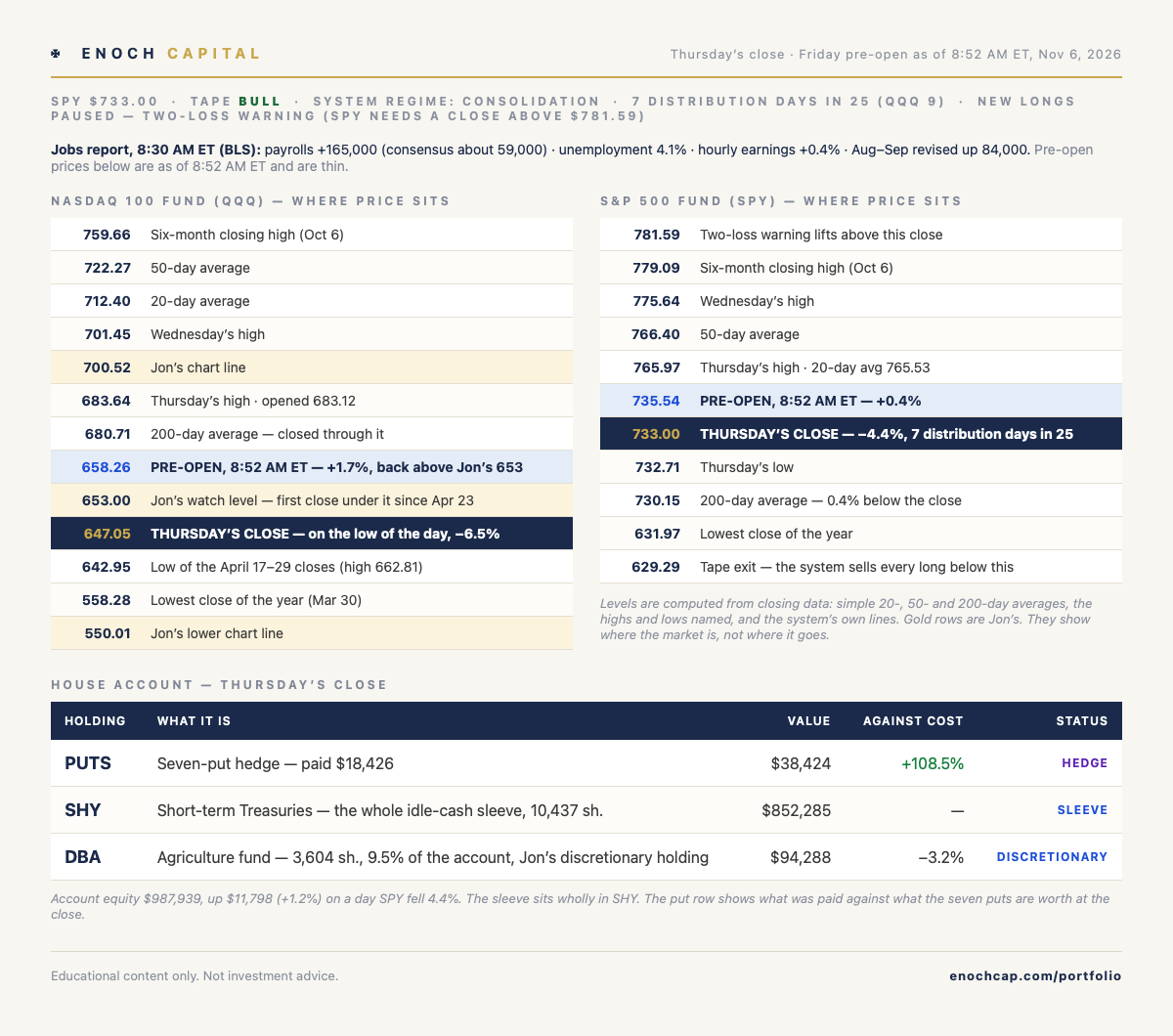
Where price sits. These levels are computed from closing data and listed from the top down. We name them so the reader can see where the market is, not to say where it will go.
Nasdaq 100 fund (QQQ), closed at $647.05:
→ $759.66, the six-month closing high (October 6)
→ $722.27, the 50-day average, and $712.40, the 20-day average
→ $701.45, Wednesday's high, the last resistance in front of Jon's chart line at $700.52
→ $683.64, Thursday's high, with the day's open at $683.12
→ $680.71, the 200-day average, which QQQ had been above and has now closed through
→ $653, the level Jon has been watching. Thursday's close is $5.95, or 0.9%, below it. It is the first close under it since April 23, when QQQ closed at $650.03; every close from April 24 through Wednesday was above it.
→ $642.95 to $662.81, the range of QQQ's closes from April 17 to April 29, and the last time it traded in this zone. Thursday's close is in the lower part of that range.
→ $558.28, the lowest close of the past year (March 30), with an intraday low of $555.60. Jon's lower chart line, $550.01, is 1.5% under that lowest close, 1.0% under the intraday low and 15.0% below Thursday's close.
S&P 500 fund (SPY), closed at $733.00:
→ $781.59, the close above which the two-loss warning lifts and the system can take new longs. Thursday's close is 6.2% below it; a gain of 6.6% would reach it.
→ $779.09, the six-month closing high (October 6), and $775.64, Wednesday's high
→ $766.40, the 50-day average, and $765.53, the 20-day average. Thursday opened at $765.47 and its high was $765.97, just under both.
→ $732.71, Thursday's low, and $730.15, the 200-day average, 0.4% below the close
→ $631.97, the lowest close of the past year, and $629.29, the line the system's tape exit uses. The tape turns, and the system sells every long, only on a SPY close below it. Thursday's close is 16.5% above it.
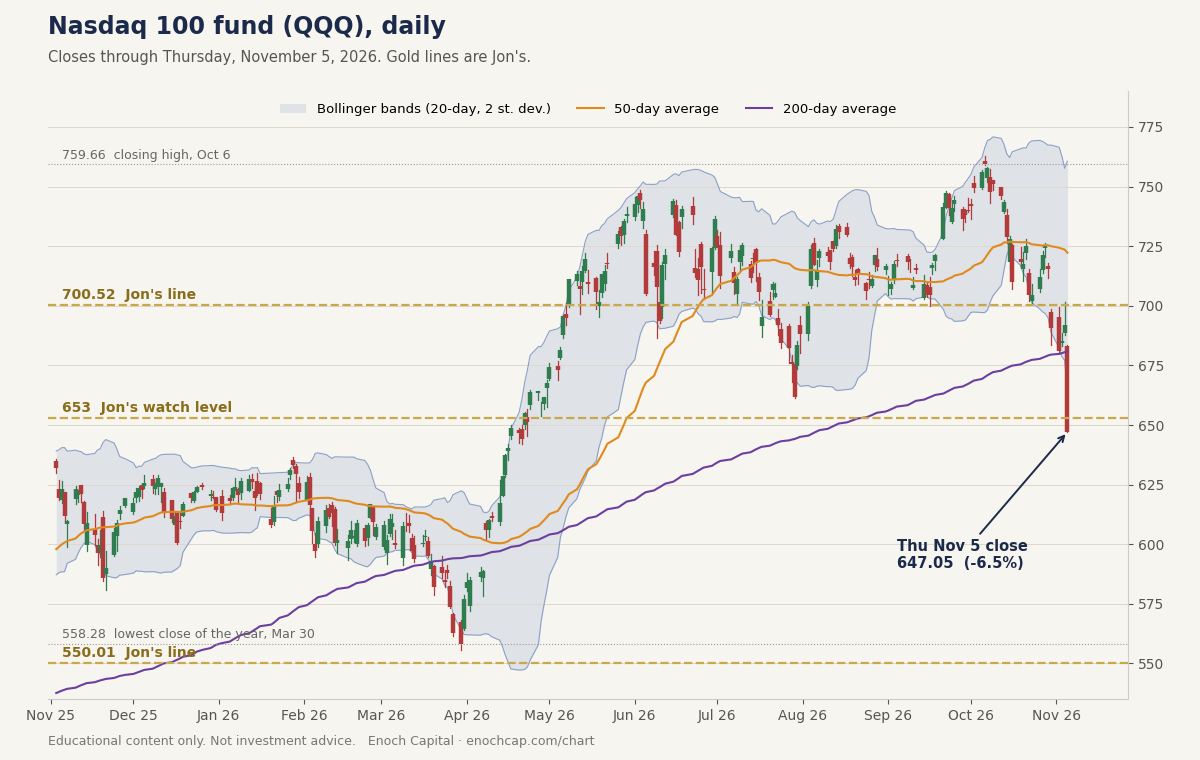
The chart, and where Jon thinks it goes. The chart below is the Nasdaq 100 fund over the past year with its 20-day Bollinger bands (the 20-day average plus and minus two standard deviations), the 50-day and 200-day averages, and Jon's three lines in gold. Thursday's close of $647.05 is under the lower band, which stood at $664.15, by 2.6%; the upper band was $760.64 and the 20-day average $712.40. A close outside the band is a measure of how far and how fast the fund moved, and nothing more.
Jon's view is in the lines. He has been watching $653 as the level that has to break, and it broke on Thursday. Below it he has drawn $550.01, 15.0% under Thursday's close and 1.5% under the lowest close of the year. Above it, $700.52 is the line a rebound would have to reach, and Thursday's open and high were both under it. Before the open QQQ is back above $653, at $658.26, but under the bottom of the April range ($662.81) and 3.4% under the 200-day average at $680.71. Jon's own read, given this morning after the jobs report, is that the market will still correct. The levels are where it can be checked: a bounce that fails under the 200-day average and the April range would fit his read, and a close back above $700.52 would not. Below $653 the next marks are the April closes at $642.95 to $662.81 and then the March low. These are his marks, drawn on a chart, and we hold them the way we hold every level here: where the market is, not a promise of where it goes.
The 200-day average is the first line in view below the S&P 500 fund, and the Nasdaq 100 fund has already closed through its own. The tape is still bull by the system's rule, which watches SPY's pivot lows and not the averages, and Thursday did not change it.
The account. The house account closed at $987,939, up $11,798, or 1.2%, from Alpaca's prior-day figure, on a day the S&P 500 fund fell 4.4%. The idle-cash sleeve is wholly in SHY, the short-term Treasury fund: the account holds 10,437 shares of SHY, $852,285. The seven puts cost $18,426 and closed at $38,424, up 108.5%. The QQQ put closed at $6,754 against $2,551 paid, and the four XLK puts at $10,320 against $4,620. Outside the sleeve and the puts the account holds one position, the Invesco DB Agriculture Fund (DBA): 3,604 shares, $94,288, 9.5% of the account, 3.2% below its cost. The account holds $2,942 in cash.
The puts were bought as insurance and sized so that the premium was the most that could be lost. Nothing about Thursday changes how they are held. The system takes no new long until SPY closes above $781.59. The scanner's list holds twenty-seven names at or near their 52-week pivots, and none triggered. Two stocks broke through their pivots on volume and cleared every gate, and the warning held the system back from both. No orders were placed on either. The nightly run also queued a small rebalance for Friday's open, a buy of 33 shares of SHY, about $2,700, since gold, long Treasuries and commodities are all off-trend and the sleeve stays in short-term Treasuries.
What is in store today and this week.
The economy. The October Employment Situation came out this morning (above). The October Consumer Price Index follows on Tuesday, November 10. CNBC reported before the release that futures priced about a 70% chance of a quarter-point rate hike at the December 8-9 meeting; we have not re-checked that figure since the report.
Earnings. Dates and times are from Nasdaq's earnings calendar.
→ Friday, Nov 6: Enbridge, Moderna, Brookfield Asset Management, Humana and Vistra before the open; Berkshire Hathaway (time not supplied)
→ Monday, Nov 9: Constellation Energy, KKR and Barrick before the open; Occidental Petroleum, Take-Two and Rocket Lab after the close
→ Tuesday, Nov 10: TransDigm and Sea before the open; CoreWeave after the close
→ Thursday, Nov 12: Cisco and Applied Materials after the close
Enoch Capital · Chart · Research & Due Diligence
→ Zero management fee. 20% performance only. 10% of that tithed.
The week ahead, per the USCCB daily readings calendar for the United States:
Holy Mary, Mother of God, pray for us.
In Christ,
Jonathan Simmons
Enoch Capital LLC
Catholic Daily goes out Monday through Saturday.
LinkedIn · X @jonenochcap · enochcap.com
Enoch Capital LLC · 2121 S. Broadway, #511, Denver CO 80210
Catholic Daily is an educational publication. It is not investment advice. References to markets, specific securities, or economic conditions are illustrative only and do not constitute recommendations to buy or sell any security. Past performance does not guarantee future results.
Enoch Capital LLC operates under the Publisher's Exemption from the Investment Advisers Act of 1940 (Lowe v. SEC, 472 U.S. 181, 1985). Nothing on this site constitutes the rendering of personalized investment advice. Enoch Capital LLC is not a registered investment adviser.