Good morning.
A man with the dropsy stood in front of the Lord at a Pharisee's table, and the guests were watching to see what Jesus would do.
Friday of the Thirtieth Week in Ordinary Time
Gospel: "And it came to pass, when Jesus went into the house of one of the chief of the Pharisees, on the sabbath day, to eat bread, that they watched him. And behold, there was a certain man before him that had the dropsy. And Jesus answering, spoke to the lawyers and Pharisees, saying: Is it lawful to heal on the sabbath day? But they held their peace. But he taking him, healed him, and sent him away. And answering them, he said: Which of you shall have an ass or an ox fall into a pit, and will not immediately draw him out, on the sabbath day? And they could not answer him to these things." — Luke 14:1-6
The Latin of the question is Si licet sabbato curare?
In the Catena Aurea, Theophylact says the question exposes them: "the day which does not admit the works of the good is accursed." Bede finds the answer in the Pharisees' own barns: "they violate the sabbath by a work of covetousness, who contend that he does so by a work of charity." And Cyril notes that the Lord did not stop to manage their offense: "it becomes us, when a great good is the result, not to care if fools take offense."
The first reading is Paul's prayer for the Philippians: "that your charity may more and more abound in knowledge, and in all understanding: That you may approve the better things" (Philippians 1:9-10), in the Latin ut probetis potiora.
The full readings are on USCCB.org.
bible.usccb.org/bible/readings/103026.cfm →
Summa Theologiae, Part II-II, question 118, article 1
Augustine, in the Catena Aurea, reads the sick man as a figure: "we rightly compare the dropsical man to a covetous rich man. For as the former, the more he increases in unnatural moisture the greater his thirst; so also the other, the more abundant his riches, which he does not employ well, the more ardently he desires them."
Aquinas asks whether covetousness is a sin, and begins with the measure. Riches are useful for an end, and whatever is ordered to an end must fit it, as medicine is commensurate with health. So "man's good in their respect consists in a certain measure", and "it will be a sin for him to exceed this measure, by wishing to acquire or keep them immoderately. This is what is meant by covetousness, which is defined as 'immoderate love of possessing.'"
He does not condemn the wanting. "It is natural to man to desire external things as means to an end: wherefore this desire is devoid of sin, in so far as it is held in check by the rule taken from the nature of the end."
The sick man in the Gospel does not lack water. His body cannot use it, so the thirst grows with the drinking. The measure Aquinas gives is a question a person can put to himself: what the money is for, and whether the wanting still answers to it.
Thursday's close: SPY $769.49, −0.4% · Nasdaq 100 −1.4% · Russell 2000 +1.0% · tape BULL, regime choppy · new longs still paused by the two-loss warning
Thursday opened lower and the S&P 500 fund stayed within a narrow range. It gapped down 0.5% to $768.79, reached a low of $766.62 and a high of $770.76, and closed at $769.49, down 0.4%. That is 1.2% below the six-month closing high of $779.10 set October 6. The Nasdaq 100 fund gapped down 1.2% and closed at $715.42, down 1.4%. The Russell 2000 fund rose 1.0% and the equal-weight S&P 500 fund 1.2%, so the index was held back by the largest names while most of the market rose. Nine of the eleven sector funds rose: health care led at +2.4%, real estate followed at +2.2%, and utilities, consumer staples and financials each rose about 1.5%. Communication services fell 1.9% and technology 1.2%.
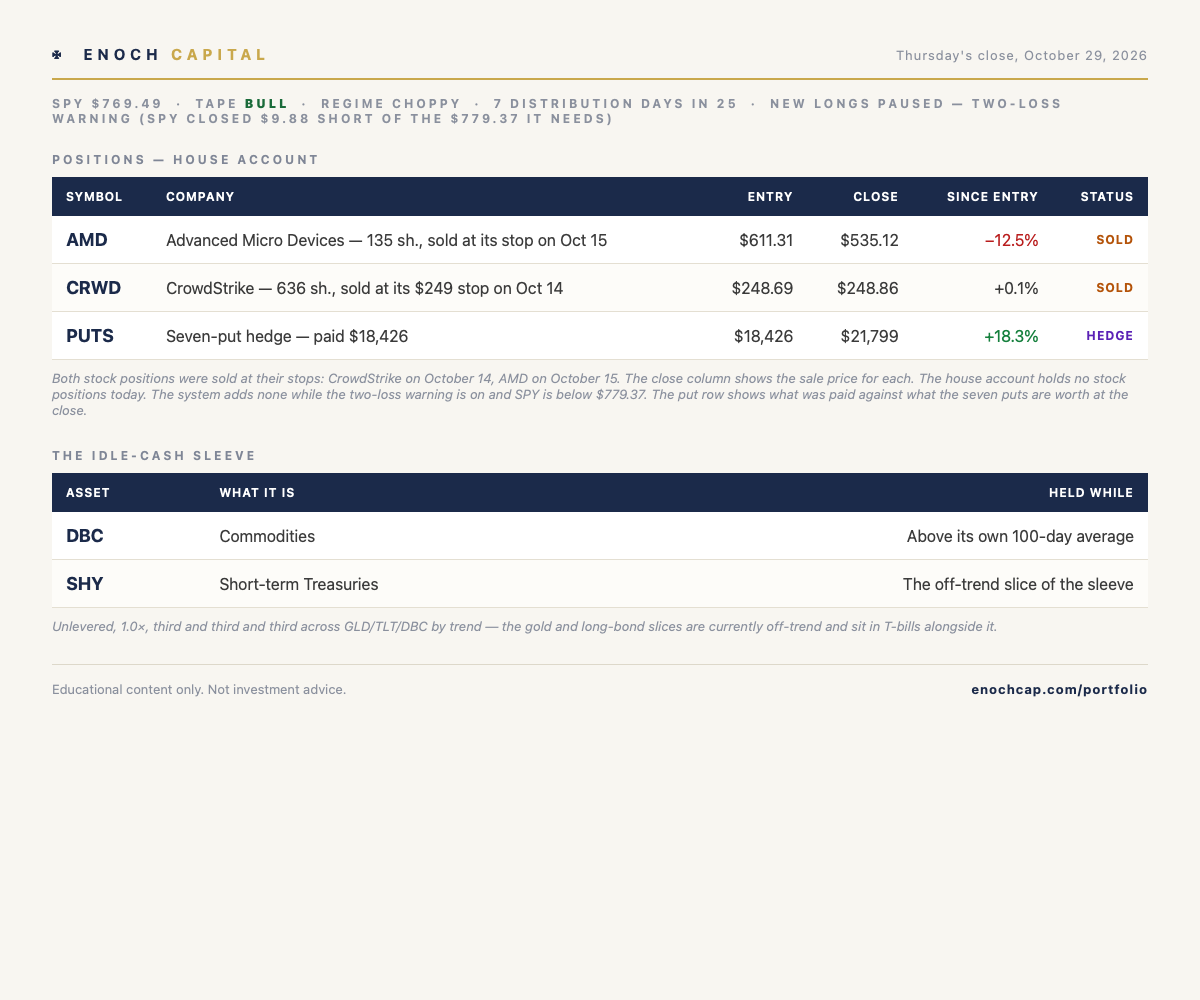
The two-loss warning is still on: the system takes no new long until SPY closes above $779.37, and Thursday's close was $9.88 short of it, 1.3% below. The tape turns, and the system sells every long, only on a SPY close below $629.29. By our own count, 7 of the last 25 sessions are distribution days for the S&P 500 fund and 8 for the Nasdaq 100 fund. The scanner's list holds thirty-three names at or near their 52-week pivots, and none triggered.
The house account holds no stock positions today. It did make one bold move Thursday morning: at my discretion, we bought the Invesco DB Agriculture Fund (DBA), 2,553 shares at $27.02, 7% of the account, paid for by selling short-term Treasuries. We feel there might be an issue with poultry coming up, and if there is, we expect demand to shift toward beef. The fund holds no poultry. Live and feeder cattle are about 21% of it, with hogs, corn, soybeans and the other grains making up most of the rest. It is a judgment call outside the system's breakout rules, it has no stop, and it was below its own 100-day average when we bought it, so the system itself would not have taken it. In the 2020 crash it fell 10.7% from February 19 to March 23. It closed Thursday at $27.55, up 1.9%. The seven puts cost $18,426 and were worth $21,799 on Alpaca's marks, up 18.3%, on a day the Nasdaq 100 fund fell 1.4%. The account closed at $993,265, up from $990,555 on Wednesday. The idle-cash sleeve is in commodities and short-term Treasuries.
Enoch Capital · Chart · Research & Due Diligence
→ Zero management fee. 20% performance only. 10% of that tithed.
The week ahead, per the USCCB daily readings calendar for the United States:
Holy Mary, Mother of God, pray for us.
In Christ,
Jonathan Simmons
Enoch Capital LLC
Catholic Daily goes out Monday through Saturday.
LinkedIn · X @jonenochcap · enochcap.com
Enoch Capital LLC · 2121 S. Broadway, #511, Denver CO 80210
Catholic Daily is an educational publication. It is not investment advice. References to markets, specific securities, or economic conditions are illustrative only and do not constitute recommendations to buy or sell any security. Past performance does not guarantee future results.
Enoch Capital LLC operates under the Publisher's Exemption from the Investment Advisers Act of 1940 (Lowe v. SEC, 472 U.S. 181, 1985). Nothing on this site constitutes the rendering of personalized investment advice. Enoch Capital LLC is not a registered investment adviser.